
The Founding Fathers’ Christian Ethnic Covenant for America
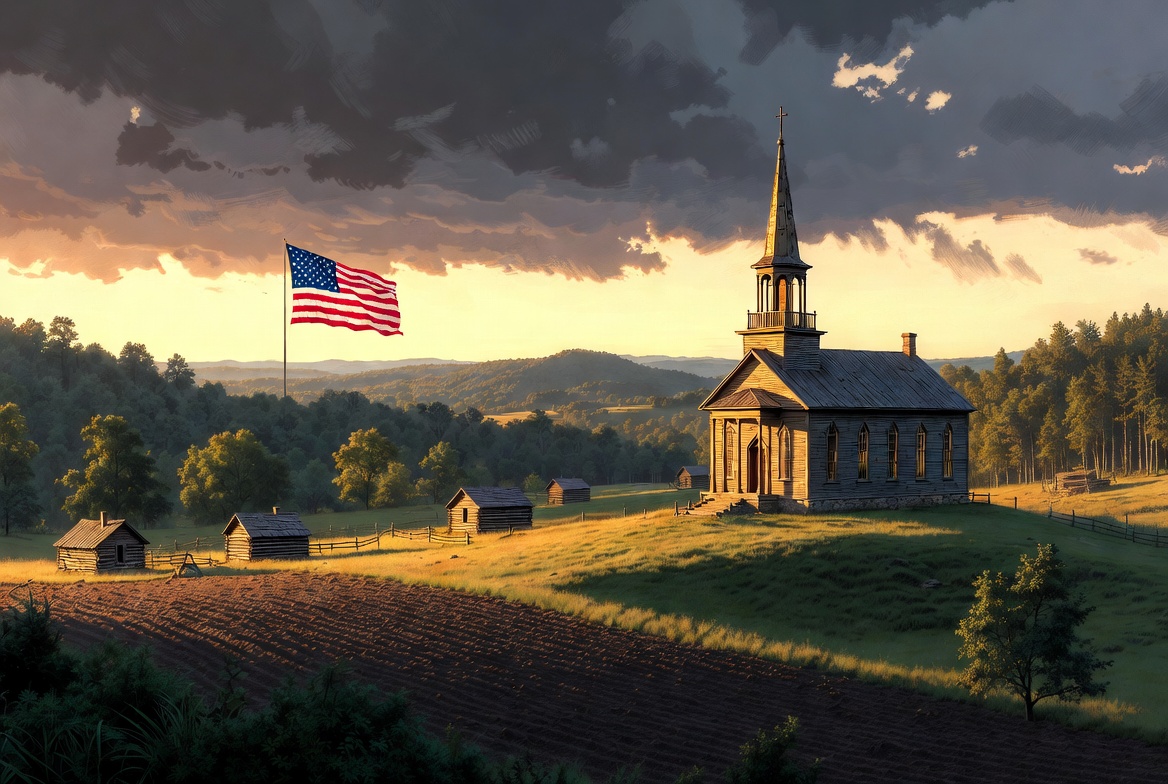
Picture the resolute Ethnic American founders—free white persons of good moral character, as defined by the Naturalization Act of 1790 they themselves enacted—gathering in Philadelphia’s sweltering halls after sacrificing blood at Saratoga and Yorktown, forging a republic from the untamed wilderness their European forebears had claimed since Jamestown. They inscribed “We the People” with the clear intent of securing blessings of liberty for themselves and their posterity, a Christian people descended from shared ancestors professing the same faith. They had tamed rivers, felled forests, built homesteads on the frontier, raised churches where the Word of God guided daily life, and established communities rooted in European Christian traditions that stretched back over 150 years of colonial experience by the time of the Constitution. This was no abstract experiment in universalism. It was a covenant rooted in blood, soil, faith, and lineage.
Now contrast that sacred covenant with today’s grotesque betrayal: mosques rising in heartland towns our ancestors settled, calls to prayer drowning out church bells, demands for Sharia accommodations in schools and courts, and elites peddling cherry-picked quotes and revisionist histories to claim Islam was always woven into America’s fabric. This is not enrichment. It is conquest by demographic stealth, displacing the Ethnic American core—those of European descent who built this nation—while rewriting history to pretend Muslims, Hindus, and other alien faiths were ever intended as part of “We the People.” Recent policy debates have only underscored what the founders understood with piercing clarity: mass Muslim immigration since 1965 represents a profound betrayal of the original covenant.
I write as a 13th-generation Ethnic American with roots to Jamestown on both sides, maternal and paternal (1610 and 1619 respectively), outraged at the theft of our inheritance. The founders did not envision minarets dotting landscapes cleared by axe and plow for European Christian settlers. They built safeguards—cultural, legal, and demographic—to preserve a homogeneous nation. Mass Muslim immigration since 1965 has betrayed that vision, turning “We the People” into “We are the World” at the expense of our posterity. Our people face genocidal replacement through demographics and religious dilution. The forefathers spin in their graves at this ongoing nightmare of cultural erasure.
The Misrepresentation of Jefferson: Locke’s Words, Not American Policy
Critics endlessly cite Thomas Jefferson: “neither Pagan nor Mahometan [Muslim] nor Jew ought to be excluded from the civil rights of the Commonwealth because of his religion.” They present this as proof of seamless inclusion. But this is intellectual dishonesty. Jefferson copied it into his notebooks from John Locke’s 1689 A Letter Concerning Toleration. The word “Commonwealth” betrays its colonial British context—America was no commonwealth under the new republic. Locke wrote under monarchy; Jefferson noted Enlightenment ideas, not binding policy for the sovereign nation forged by Ethnic Americans. This was not official policy; it was merely personal note-taking by Jefferson in one of his hundreds of notebooks while reading Enlightenment thinkers. The decisive action against the Barbary threats reveals Jefferson’s true stance far more accurately than any notebook jotting: security and civilizational compatibility must always prevail over abstract notions of tolerance.
One common claim is that Jefferson’s ownership of a Quran proves deep affinity and influence on American founding principles. Proponents argue he bought it as a law student to study Islamic legal systems, influencing the Virginia Statute for Religious Freedom and broader tolerance. Some even suggest Quranic ideas shaped “life, liberty, and the pursuit of happiness.” This is fantasy. Jefferson owned many books on various religions and philosophies as a scholar. His Quran was primarily to understand the Barbary Pirates’ motivations—Muslim states demanding tribute based on Quranic doctrine of conquest. In 1786 meetings with Tripoli’s ambassador, Jefferson learned firsthand of Islamic justifications for piracy and enslavement: “it was written in their Koran, that all nations who should not have acknowledged their authority were sinners, that it was their right and duty to make war upon whoever they could find and to make Slaves of all they could take as prisoners.” He waged war against them, not embraced their faith. Far from positive influence, Jefferson critiqued Islam for stifling free inquiry and combining religion with government.
The Treaty of Tripoli and Other Fabrications
The secularists’ silver bullet? Article 11 of the 1797 Treaty of Tripoli: “As the Government of the United States of America is not, in any sense, founded on the Christian religion…”. Brandished like gospel, it’s anything but.
Enter Joel Barlow, U.S. Consul in Algiers—a Revolutionary War chaplain turned diplomat, freethinker, and poet who aided Thomas Paine’s Age of Reason but never pastored a flock. Barlow translated it to English, inserting Article 11 — which is completely absent from the original Arabic version. Look for yourself (Ctrl-F “Christian religion” yields nothing). A rambling letter from the Dey of Algiers flattering Adams was irrelevant boilerplate. The 1930 State Department analysis confirms the mismatch. This isn’t a founding doctrine; it’s a translator’s sleight-of-hand in a pirate payoff. A forgery exposed, crumbling the secular myth.
Washington’s Farm Labor, Not the Republic: Context of the Tilghman Letter
Another favorite: George Washington’s words to Tench Tilghman: “The bosom of America is open to receive the oppressed… They may be Muslims, Jews or Christians… if they are good workmen.” This is wrenched from a 1784 letter about hiring farm laborers at Mount Vernon. Washington discussed practical workers—Asians, Africans, Europeans, even atheists—for his estate operations. He did not advocate citizenship, voting rights, or cultural integration into the body politic. Blacks worked his farm too, yet the founders did not deem them full citizens under the Constitution’s 3/5 clause or naturalization laws.
Advocates claim Washington and founders “explicitly included Islam” in visions of the republic, citing this letter and supposed Muslim slaves on his plantation. They argue this shows preparedness to incorporate Muslims as citizens. Nonsense. Washington signed the Naturalization Act of 1790 restricting citizenship to free white persons. Any Muslim slaves were chattel, not citizens or equals. The letter addressed labor, not the political community. In his Farewell Address, Washington emphasized unity of shared principles among a specific people, warning against foreign influences that could dilute it. Welcoming individual workers for practical needs does not mean surrendering the republic or granting full membership in the body politic to those whose faith and customs stand fundamentally opposed to the founders’ vision.
Elliot’s Debates and Virginia Documents: Explicit Christian Framework
The Constitutional ratifying conventions in Jonathan Elliot’s Debates show delegates rejecting the idea of Muslims (“Mahometans”) in office, viewing them as incompatible. Concerns were raised that without religious tests, “pagans, deists, and Mahometans” might hold office, with responses affirming the Christian character of the electorate would prevent it. The Virginia Declaration of Rights (1776) by George Mason states in Article 16 the mutual duty “to practice Christian forbearance, love, and charity.” Not generic tolerance, but Christian forbearance among a Christian people. The Virginia Statute for Religious Freedom disestablished the Church of England but said nothing about Muslims, Hindus, or infidels taking root as equals. Anyone reading the original document sees its narrow focus—no endorsement of alien religions reshaping the republic. This is the very document the Bill of Rights was based on!
John Jay and the Ethnic Christian Definition of “We the People”
John Jay defined “We the People” in Federalist No. 2 as “one united people—a people descended from the same ancestors, speaking the same language, professing the same religion” (Christianity). This reflects the 150+ years of colonial experience forming a distinct American ethnicity—European and Christian. The founders built for this people, not a multicultural experiment that would erode their posterity.
Table: Key Founding-Era Statements on Religion, Ethnicity, and Citizenship
| Statement/Source | Context | Implication for Non-Christian Faiths and Ethnicity | Source Notes |
|---|---|---|---|
| Virginia Declaration of Rights, Article 16 (1776) | Precursor to Bill of Rights by George Mason | Christian forbearance as the standard among a Christian people | Avalon Law Project |
| Elliot’s Debates (1787-1789) | Ratification debates on religious tests | Muslims and pagans not to hold office; Christian consensus as safeguard | Library of Congress |
| Naturalization Act (1790) | Signed by Washington | Limited to free white persons of good moral character | US National Archives |
| John Jay, Federalist No. 2 (1787) | Definition of unified people | Protestant Christian homogeneity and shared European ancestry essential | Avalon Law Project |
| Washington Farewell Address 1796 | Unity and foreign influence | Shared principles and manners required; no mass alien faiths | Avalon Law Project |
Rebutting the Full Suite of Muslim Claims to American Belonging
Proponents push several arguments to claim Islam’s deep roots in America. I rebut them directly with historical facts, exposing how these claims distort the founding covenant and serve modern displacement agendas.
- Muslims arrived in America before Columbus or Protestant settlers. Turkish President Erdogan and others assert Muslim sailors reached America in 1178, with mosques in Cuba per Columbus’s diary, or earlier Abbasid contacts influencing natives. They cite pre-Columbian coins, maps by al-Idrisi, or Estevanico in 1527 as evidence of foundational presence.
- Rebuttal: These are fringe, debunked claims lacking credible archaeological or historical proof. No mainstream historian accepts pre-Columbian Muslim settlement as fact. Spanish records, excavations, and Native accounts show no lasting Islamic communities or mosques. Such myths serve modern identity politics and demographic justification, not truth. Our Ethnic American founding traces to Jamestown’s Christian settlers in 1607 and the Puritan migrations that established a distinctly European Christian society.
- Enslaved African Muslims were foundational, numbering thousands in 1776, making Islam part of the fabric. Advocates cite figures like Omar ibn Said and argue the founders knew and accommodated them, proving early integration.
- Rebuttal: Enslaved Muslims existed but were bondsmen, not citizens, voters, or cultural influencers. The founders showed little awareness of their specific faith in constitutional or policy debates. Slavery itself contradicted the long-term covenant for a free white Christian posterity. Their presence as chattel grants no modern claims to reshape the nation demographically or religiously. Naturalization laws explicitly excluded non-whites from “We the People.”
- Founders’ tolerance quotes, Quran ownership, Supreme Court frieze of Muhammad, and Franklin’s hypothetical meeting house prove inclusion. They highlight Jefferson’s Statute supposedly protecting “Jew and Gentile, Christian and Mahometan,” and decorative elements as evidence of pluralism.
- Rebuttal: Hypothetical tolerance for rare individuals does not equal structural integration, mass immigration, or cultural equality. Quotes operated strictly within a Christian moral framework, as Mason’s “Christian forbearance” makes explicit. The frieze is artistic decoration, not policy endorsement. Franklin’s remarks were aspirational thought experiments. None of these override the 1790 Naturalization Act or the clear Christian ethnic consensus in Elliot’s Debates and state constitutions.
- America’s religious freedom tradition under the First Amendment mandates unlimited Muslim immigration and influence. Proponents twist the Amendment and modern “diversity, equity, and inclusion” rhetoric to demand transformative numbers and accommodations like Sharia courts or prayer rooms everywhere.
- Rebuttal: The First Amendment prevented a national established church but presupposed a Christian moral foundation for the republic, as evidenced throughout state constitutions and ratification debates. It protects private practice, not the right to import theocratic systems that undermine republican liberty or create parallel societies. The founders viewed faiths like Islam, with its history of conquest and theocratic governance, as incompatible with the ordered liberty they established for their Christian posterity.
- Muslims contribute economically and culturally, enriching the nation as doctors, engineers, and taxpayers. They point to successful individuals and historical presence to argue net benefit.
- Rebuttal: Selective individual successes do not override doctrinal incompatibility with Western liberty—jihad theology, supremacism, and gender norms that clash with our traditions. Aggregate patterns reveal higher welfare dependency in many cohorts, terror incidents, grooming scandals, honor violence, and enclave formation that erode social trust. Costs to Ethnic American communities—strained schools, hospitals, policing, and lost political voice—are immense and well-documented. These outcomes confirm the founders’ wisdom in limiting the body politic to those sharing our ethnic and religious character.
- America has always been a pluralistic nation open to all faiths without restriction. Some twist isolated quotes and early diplomatic contacts as proof of seamless inclusion.
- Rebuttal: Early diplomatic contacts, such as the Barbary Wars, demonstrated conflict, not harmony. The founders distinguished limited toleration for individuals from structural integration of alien faiths that could undermine the republic. John Jay’s definition of “one united people… professing the same religion,” combined with the Naturalization Act of 1790 and explicit concerns in Elliot’s Debates, proves America was designed as a Christian nation for a Christian people of European descent. Mass Muslim immigration since 1965 represents a radical betrayal of that covenant, not its fulfillment.
Demographic Shell Game, Census Manipulation, and the Human Cost
Today’s displacement hides behind inflated “White” categories that lump near-whites, some Latinos, and others while the 1924 Supreme Court case United States v. Bhagat Singh Thind ruled even high-caste Indians not White. Muslims, once near zero, now number millions with higher birth rates and chain migration amplifying the shift. This is engineered erasure. In Minnesota and Michigan, enclaves transform neighborhoods our grandparents built. Imagine an Ethnic American family in Minneapolis watching their church close as a mosque expands, schools adopt foreign curricula elements, safety erodes under incompatible norms, and taxes fund parallel societies. Costs mount: welfare burdens documented by the Center for Immigration Studies, social trust collapse, terror risks, and cultural loss. Our people are being genocided demographically and religiously.
Legislative, Judicial, and Institutional Complicity
The betrayal runs deep across institutions. Congress passed the 1965 Hart-Celler Act under false assurances of no demographic change, opening floods from non-European, non-Christian nations. Subsequent amnesties, refugee programs, and lax enforcement imported millions often bringing incompatible norms. Judges twisted the 14th Amendment—never intended for birth tourism or illegal aliens—into universal birthright citizenship, ignoring original jurisdiction limits. Courts have shielded sanctuary policies and blocked enforcement, colluding with executives prioritizing globalism over the founding covenant.
This complicity spans decades of cowardice: lawmakers terrified of “racist” labels more than the dissolution of their own people; judges legislating from the bench against original intent; and bureaucracies enforcing policies that deliberately erode the 1790 standard. The human toll includes Ethnic American communities strained by crime multipliers, welfare loads, trust erosion, and spiritual displacement—mosques rising where churches once stood, foreign holidays eclipsing ours. Quantified impacts from sources like the Center for Immigration Studies reveal billions in net costs, lost wages for native workers, and heightened security threats. Full restoration demands we dismantle the post-1965 Hart-Celler framework entirely and return unapologetically to the founders’ clear ethnic and religious boundaries.
Universities, media, and NGOs promote “Islamophobia” hysteria while ignoring founder warnings in Elliot’s Debates and Virginia documents. The Census Bureau manipulates categories to obscure the Ethnic American decline. Foreign lobbying and captured agencies push more visas, further accelerating the displacement of the very people who built this nation.
Call to Action
Ethnic Americans must reclaim the narrative without apology. Demand enforcement of original 1790 intent: strict vetting based on compatibility, indefinite pauses on immigration from incompatible regions, repeal of chain migration and anchor mechanisms, honest census definitions that reject the shell game, and public reaffirmation of our Christian foundations. Educate family and neighbors on Elliot’s Debates, Mason’s Christian forbearance, and Jay’s definition of our people. Organize locally to preserve communities, litigate against overreach, and vote as if our posterity’s survival depends on it—because it does. Speak unapologetically. Stand firm with policies that honor our founders and defend the inheritance they left us.
© James Sewell 2026 – All rights reserved
A personal note from James Sewell
Fellow Ethnic Americans, the blood of Jamestown survivors and frontier builders courses through our veins. They did not tame this land for its dilution into a babel of alien faiths and demographic conquest. The covenant is ours to defend. We must win this battle against replacement. The hour is late, but not lost.
For more information on the Christian Founding of America, please read—Part XIV (Our Religion) – Announced on X: here – (24 minute read time)
Pingback:The Ethnic American Library - Ethnic American