A Call to Awareness
Fellow Ethnic Americans—the direct and unbroken descendants of those resolute European pioneers who braved the Atlantic’s fury to establish Jamestown in 1607 amid starvation and Indian attacks, who planted the seeds of faith and freedom at Plymouth in 1620 while half their number perished in the first brutal winter, who cleared vast tracts of wilderness with axe and plow, who fought and bled for independence from a distant tyrant at places like Lexington, Concord, Bunker Hill, and Saratoga, who endured the freezing encampment at Valley Forge under General Washington’s steadfast leadership, and who ultimately crafted a Constitution and Declaration of Independence dedicated explicitly to securing the blessings of liberty for “ourselves and our Posterity”—we now face the most insidious and dangerous front in the ongoing war against our people: the systematic conquest of our culture, our shared history, and our very minds.
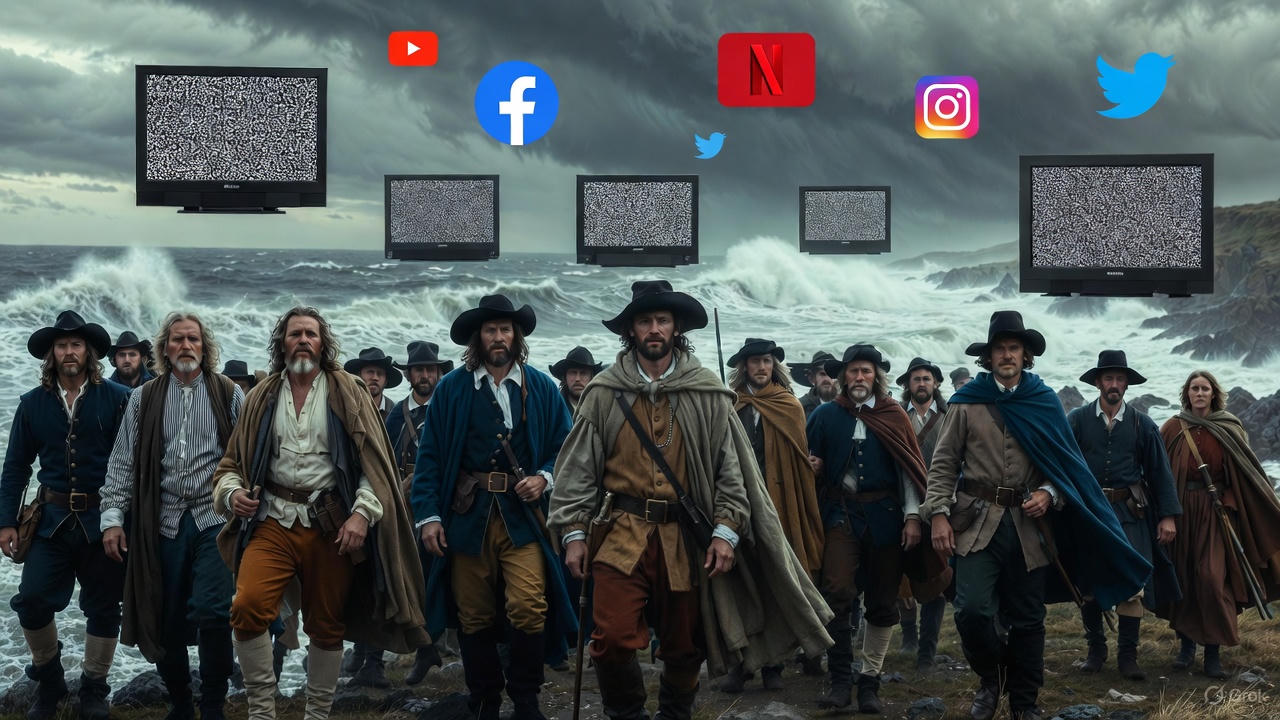
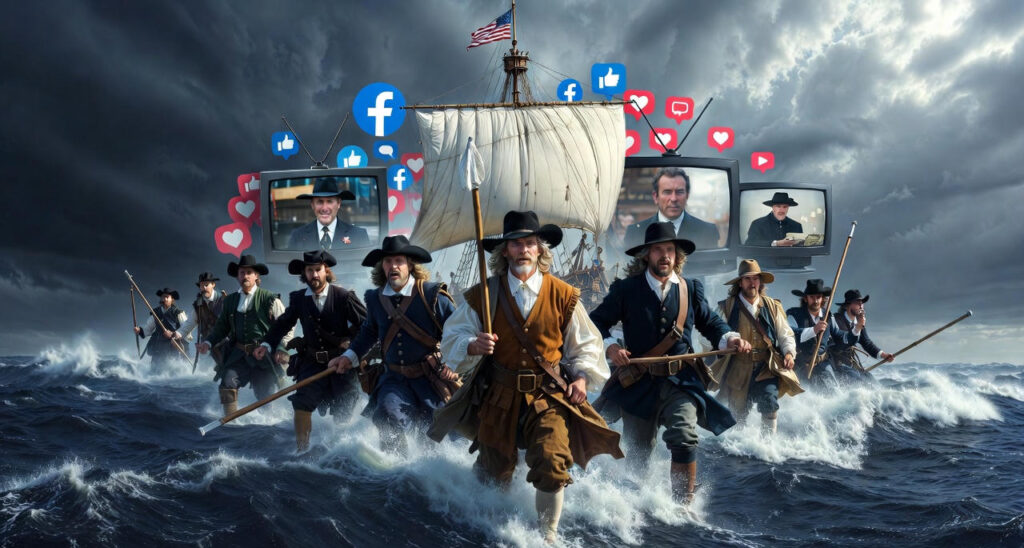
The physical displacement—through deliberately unguarded borders, unchecked demographic tides, and policies that prioritize foreign peoples over the founding stock—has been accompanied by a parallel and equally devastating assault on the realm of ideas, narratives, and collective identity. Controlled media conglomerates, Hollywood studios with their global reach, elite academic institutions, public school systems, and the algorithmic gatekeepers of social media platforms all work in near-perfect concert to propagate narratives that systematically vilify our European heritage as inherently oppressive and racist, that instill deep-seated guilt in our children from the earliest ages, and that portray any defense of Ethnic American identity, interests, or continuity as the ultimate moral evil—bigotry, hatred, or “supremacy.”
This is nothing less than psychological warfare waged on a massive scale, far more sophisticated than anything King George III could have imagined. It directly excites domestic insurrections of the soul (paralleling Grievance #23 in the Declaration of Independence) by deliberately turning Ethnic Americans against their own kin through manufactured self-hatred, intergenerational division, and a false consciousness that celebrates our own diminishment. It constrains us to reject our ancestral legacy (as in Grievance #24) by enforcing a rigid ideological conformity that demands we applaud policies and cultural shifts that lead inexorably to our erasure, framing such surrender as the highest virtue.
The founders understood profoundly the power of narrative control in any struggle for freedom. Thomas Paine’s Common Sense was not some lengthy academic treatise intended only for the educated elite; it was a blunt, accessible, and incendiary pamphlet that spoke directly to ordinary farmers, merchants, tradesmen, and laborers in language they could immediately grasp and rally behind. Published anonymously on January 10, 1776, in Philadelphia, it sold an astonishing 120,000 copies in just the first three months alone—in a scattered colonial population of roughly 2.5 million people, many of whom were loyalists, neutrals, slaves, or indifferent. Proportionally, that would be equivalent to selling 50-60 million copies in modern America. Paine demolished arguments for continued loyalty to the British Crown with simple, relentless logic: why should free-born men submit to a distant hereditary monarch who taxed them without representation and quartered troops in their homes? Copies were read aloud in taverns, churches, militia gatherings, and town squares; they were passed hand-to-hand and reprinted on whatever presses were available across the colonies. Other pamphlets amplified the revolutionary message—Samuel Adams’ inflammatory calls to resistance published under pseudonyms, John Dickinson’s more measured but still powerful Letters from a Farmer in Pennsylvania, the anonymous broadsides that circulated in Boston and New York—all fueled by a relatively free press that the colonists still controlled, despite repeated British attempts to seize printing equipment, intimidate printers, and suppress dissenting publications.
Today, no such freedom exists for voices defending Ethnic American interests. A handful of interconnected conglomerates and tech giants hold near-monopoly power over the flow of information, and they wield it ruthlessly to suppress truths that threaten the displacement agenda while amplifying lies specifically designed to weaken our resolve, divide our families, and alienate our youth from their birthright. This lengthy installment exposes the full machinery of this cultural conquest in exhaustive detail: the historical consolidation of media ownership and the persistent ethnic patterns that shape its ideological bias; the day-to-day mechanisms of selective reporting that deliberately hide the true human costs of immigrant crime and border chaos; extended case studies of stories that are systematically buried or grotesquely distorted; Hollywood’s long and deliberate transformation from patriotic storytelling to systematic guilt injection and cultural subversion; the 1619 Project’s distortions examined claim by claim with historical counter-evidence; the raw human reality of our children becoming outnumbered minorities in their own classrooms and the psychological toll it exacts; the sophisticated and multi-layered censorship apparatus built through government-tech collusion; direct historical ties to the founders’ grievances, including reinterpretations from the addendum; and a comprehensive, actionable plan for building independent Ethnic American media institutions to finally reclaim our voice and preserve our posterity.
The Consolidation of Media Power: From Diversity to Oligopoly and Ideological Uniformity
The American media landscape was once a vibrant, chaotic ecosystem of competing voices—thousands of independent newspapers serving local communities, regional radio stations reflecting distinct viewpoints, small film companies producing varied content, and pamphlets circulating freely. In the early 20th century, Ethnic Americans had outlets that openly defended immigration restrictions like the 1924 Immigration Act and argued for cultural preservation without fear of universal condemnation. Irish, Italian, German, and Scandinavian papers advocated vigorously for their communities while still identifying with the broader European-American core.
That world has been systematically dismantled. Deregulation beginning in the Reagan era and accelerating dramatically with Bill Clinton’s Telecommunications Act of 1996 removed longstanding barriers to cross-ownership and unleashed a wave of mergers and acquisitions that concentrated power in fewer and fewer hands. Today, six corporate giants control over 90% of what Americans see, hear, and read on a daily basis:
- The Walt Disney Company owns ABC News, ESPN, Marvel Entertainment, Pixar, Lucasfilm, 20th Century Studios, a majority stake in Hulu, and dozens of cable channels reaching hundreds of millions.
- Comcast/NBCUniversal controls NBC broadcast network, MSNBC, CNBC, Universal Pictures, Peacock streaming service, Telemundo, and a vast array of cable properties.
- Warner Bros. Discovery owns CNN, HBO, TBS, TNT, DC Comics, Discovery Channel, and the former Turner Broadcasting networks.
- Paramount Global owns CBS, MTV, Nickelodeon, Showtime, Paramount Pictures, and numerous other entertainment brands.
- Sony Pictures and emerging streamers like Netflix operate as partial outliers, but even they conform closely on cultural and political messaging.
Cross-ownership extends into what remains of print media and digital news aggregators. Overlaying this corporate structure are the massive institutional investors—Vanguard, BlackRock, and State Street—who collectively manage trillions and hold significant stakes in every major player, enforcing coordinated agendas through “stakeholder capitalism,” ESG scoring systems, and shareholder activism that prioritize ideological conformity over journalistic integrity or truth-seeking.
This concentration alone would be profoundly dangerous to a free society. But the leadership demographics add another critical layer that cannot be ignored. Hollywood was founded almost entirely by Eastern European Jewish immigrants—Adolph Zukor founding Paramount, Louis B. Mayer building MGM, Harry Cohn at Columbia, the Warner brothers, Carl Laemmle at Universal. They created an empire. That entrepreneurial legacy persists in modern times: executives like Disney’s Bob Iger, Warner Bros. Discovery’s David Zaslav, Paramount’s Shari Redstone family influence, and countless producers, agents, and studio heads reflect a disproportionate Jewish representation far beyond the roughly 2% population share. This is not sinister conspiracy theory; it is observable reality documented in respected books like Neal Gabler’s An Empire of Their Own: How the Jews Invented Hollywood and countless industry profiles and demographic analyses.
The result is a media ecosystem where content consistently critiques traditional European-American society—portraying rural and working-class whites as ignorant bigots, founding fathers as hypocritical slaveowners, Western civilization as a story of oppression and conquest—while celebrating unlimited multiculturalism as the unquestionable highest good. Ethnic American concerns about demographic displacement, cultural erosion, or preservation are almost universally framed as “hate,” “extremism,” or “white supremacy,” while narratives justifying and accelerating replacement dominate airwaves, screens, and curricula. This uniformity is not accidental; it is the product of a closed system where dissent is punished through cancellation, blacklisting, and career destruction, ensuring that only approved messages reach the public. Journalists who stray from the line find themselves unemployed or relegated to fringe outlets; writers who question the diversity dogma are denied access to sources or platforms. The chilling effect is total, creating an environment where self-censorship becomes the norm long before any official sanction is applied. You feel it every day: the hesitation before speaking plainly at work, the careful wording in family group chats, the knowledge that one misstep can cost you your job or social standing. This is control, plain and simple, and it hits hardest at ordinary Ethnic Americans who just want to live in the country their ancestors built without being told they’re the problem.
Selective Reporting: How Media Deliberately Hides the Human Costs of Displacement and Crime
The bias embedded in this structure is most blatant and damaging in coverage of immigration, crime, and border issues. Mainstream outlets repeatedly cling to the narrative that immigrants commit crimes at lower rates than native-born citizens, citing outdated, methodologically flawed, or cherry-picked studies while ignoring massive systemic flaws in data collection.
They consistently ignore underreporting in immigrant communities—where victims may fear deportation, lack English proficiency, distrust authorities due to experiences in home countries, or face cultural stigma against involving police. They ignore state-level data from jurisdictions that actually track citizenship status, such as Texas, which has repeatedly shown non-citizens convicted of homicide, sexual assault, and other serious crimes at rates multiple times higher than citizens.
High-profile cases illustrate the pattern with chilling clarity:
- Laken Riley, a vibrant 22-year-old nursing student murdered while jogging on the University of Georgia campus in February 2024 by a Venezuelan migrant who had been released at the border—initial national coverage focused on abstract “immigration policy debate,” quickly faded into obscurity, and was never framed as part of a larger preventable pattern.
- Kate Steinle, shot and killed on a San Francisco pier in July 2015 by an illegal immigrant with seven felony convictions and multiple prior deportations—the case briefly sparked outrage and contributed to “Kate’s Law” proposals, but was rapidly suppressed and reframed as “politicizing a tragedy” or an argument for gun control.
- Countless lesser-known but no less heartbreaking cases:
- Mollie Tibbetts in Iowa, murdered by an illegal immigrant in 2018 while out for a run.
- Kayla Hamilton, a 20-year-old autistic girl killed in Maryland in 2022 by an MS-13 member who crossed as an unaccompanied minor.
- Ruby Garcia in Michigan, shot by an illegal immigrant in 2024.
- Rachel Morin, raped and murdered on a Maryland trail by a Salvadoran fugitive.
- Young girls assaulted in small towns across the heartland.
- Families devastated by drunk-driving illegal immigrants who should never have been in the country
- Communities terrorized by gangs like MS-13 or the Venezuelan Tren de Aragua that have been allowed to establish footholds due to sanctuary policies and lax enforcement.
Local news might report the facts briefly, but national networks either ignore them entirely or move on within days unless the perpetrator fits a narrative useful for attacking Ethnic American concerns.
Meanwhile, border surges—over 20 million illegal encounters since 2021, plus millions more “got-aways”—are almost invariably framed as humanitarian success stories of “asylum seekers,” “dreamers,” and “families fleeing violence and poverty.” The massive strain on public schools (classrooms overflowing, English-language learners overwhelming resources and slowing education for all), hospitals (emergency rooms closing under billions in uncompensated care), housing markets (rents and home prices skyrocketing as migrants are resettled in heartland towns), and public safety goes systematically unreported or grossly downplayed.
The fentanyl epidemic—flooding through the open southern border and killing over 100,000 Americans yearly, disproportionately young people in rural and working-class Ethnic American communities—receives occasional mention as a “public health crisis,” but is rarely connected directly to border policy failures or the politicians and activists who enable them. The human toll on Ethnic American families—shattered lives, orphaned children, devastated towns—is effectively erased from the national consciousness. Instead, stories of “migrant contributions” and “vibrant diversity” dominate, painting a false picture of harmony while our communities bear the real costs in silence. The reality is we are at war with the Drug Cartels and we are losing badly. According to CDC WONDER and NIDA overdose statistics we have lost over 900,000 Americans since 2000 that link directly to Cartels.
This selective media blindness extends to economic impacts: wages depressed in construction, agriculture, and service industries as cheap labor floods the market, yet reports celebrate “job growth” without mentioning who benefits and who loses. You see it in your own paycheck, in the closed factory down the road, in the higher bills at the grocery store—real effects dismissed as “myths” by talking heads who never set foot in your town.
Hollywood’s Long March from Patriotism to Cultural Subversion and Guilt Injection
Hollywood was not always a vehicle for cultural replacement. In the Golden Age from the 1930s through the 1950s, it produced countless films celebrating the American story and Ethnic American grit: Yankee Doodle Dandy honoring George M. Cohan, Sergeant York portraying a humble Tennessee hero, John Wayne westerns that romanticized the frontier spirit and pioneer courage, war epics like The Longest Day and Saving Private Ryan (later) honoring the sacrifice of ordinary soldiers.
The shift began gradually in the countercultural 1960s and 1970s with films questioning authority and tradition, accelerated in the 1990s with increasing focus on identity politics, and has now reached a point where nearly every major release includes explicit lectures on diversity, colonialism, systemic racism, or white guilt. Superhero blockbusters pause high-stakes action for monologues on historical oppression. Historical dramas obsessively emphasize slavery, Native displacement, or imperial sins while ignoring broader context, abolitionist triumphs, or the unique American journey toward greater liberty.
Remakes routinely race-swap traditionally European characters or rewrite source material to center minority perspectives. Streaming series portray rural or working-class whites as ignorant, hateful bigots; traditional families as dysfunctional or repressive; Christianity as hypocritical or dangerous. The consistent message beamed into millions of homes nightly: European-American identity is something toxic to overcome, not a heritage to celebrate or preserve. This is not entertainment; it is indoctrination, designed to make our children ashamed of their ancestors and accepting of their own displacement. Even children’s programming—cartoons and educational shows—now includes segments on “privilege” and “inclusion” that subtly or overtly target European-descended kids with messages of collective guilt. Turn on the TV with your kid and watch how quickly the subtle digs start—the heroes who look nothing like your family, the villains who talk like your grandfather.
The 1619 Project: A Detailed Catalog of Historical Distortions and Ideological Agendas
The New York Times’ 1619 Project, launched in 2019 and rapidly embedded in thousands of school curricula across the country, boldly asserts that America’s “true founding” occurred in 1619 with the arrival of the first enslaved Africans, not in 1776 with the Declaration of Independence. Its central claims have been widely and thoroughly debunked by historians across the political spectrum, yet it persists as a cornerstone of modern education.
Key distortions include:
- The claim that the American Revolution was fought primarily to preserve slavery. In reality, while slavery existed in all colonies—including the North, where it made up small but real percentages of the population (e.g., around 3-6% in states like New York and New Jersey)—and some Southern planters feared British abolitionist leanings, the Revolution’s main drivers were taxation without representation, trade restrictions, and self-governance. Many Northern colonies were already moving toward abolition; prominent founders like Benjamin Franklin, Alexander Hamilton, and John Jay were active abolitionists.
- 1794 – George Washington signed into law The Slave Trade Act – forbidding any American ships from carrying slaves.
- 3 years after the founding of America
- 1807 – The Act Prohibiting Importation of Slaves of 1807 – Signed into Law by Thomas Jefferson.
- 17 years after the founding of America.
- 1794 – George Washington signed into law The Slave Trade Act – forbidding any American ships from carrying slaves.
- The assertion is that slavery was the primary engine of American prosperity and capitalism by 1776. This overstates the case dramatically. Slavery was tragic and widespread, especially in the South, but Northern economies—trade, shipping, manufacturing, small farms—thrived largely on free or indentured labor. Indentured servitude was common earlier in the colonial period (many European immigrants arrived bound for years of service), and while it had declined by 1776, it still played a role alongside wage labor. The explosive cotton boom that made slavery the dominant economic force in the South came later, after Eli Whitney’s 1793 cotton gin invention revolutionized production. America’s true wealth in 1776 derived from a mix: innovation, abundant land, free labor markets in the North, entrepreneurial spirit, and yes, slave labor in the South—but not as the singular “engine” the Project claims.
- Overbroad claims that modern American institutions—from healthcare to traffic to sugar consumption—are rooted in slavery. These analogies stretch historical connections to the breaking point, ignoring post-Civil War reforms, immigration waves, and America’s unique progress toward racial equality compared to the rest of the world.
Even historians initially consulted for the project distanced themselves after publication, citing factual errors and ideological overreach. Quiet corrections were made without full acknowledgment, yet the project continues to shape textbooks, teacher training, and classroom lessons, teaching generations of children that their European-descended heritage is irredeemably tainted. It has inspired school assignments where students are asked to “confront” their “complicity” in historical wrongs, further deepening the psychological divide. Your kid comes home from school repeating lines about how “America was built on stolen land and stolen labor”—lines drilled into them by teachers following state-approved materials—and you realize the fight isn’t just at the border; it’s at the dinner table.
Becoming Minorities in Our Classrooms: The Human Reality and Psychological Toll
Public school demographics paint a stark and accelerating picture. According to the National Center for Education Statistics, non-Hispanic white students fell from approximately 51% of public enrollment in 2012 to around 46% by 2023, with rapid declines in key states. In California, Texas, Florida, New York, and many urban districts, European-descended children are already minorities—often significant minorities—in the very classrooms built and funded by their ancestors.
These children sit in environments where curricula frame their forebears as oppressors, celebrate “diversity” initiatives that explicitly exclude pride in European heritage, and train teachers in concepts derived from critical race theory—labeling traits like punctuality or individualism as “white supremacy culture.” Bullying or social ostracism for perceived “privilege” often goes unaddressed or is tacitly encouraged.
The psychological toll is immense and growing: higher rates of anxiety, depression, identity confusion, and lowered self-worth among white students in heavily diverse schools, as documented in various psychological studies and anecdotal reports from parents and educators. Our youth are being systematically alienated from their birthright, taught to view their own existence as a historical wrong to be atoned for rather than a legacy to build upon. Parents report children coming home ashamed of their skin color, rejecting family traditions, or internalizing the idea that their success is unearned “privilege” while others’ struggles are solely due to “systemic racism.” This is not education; it is psychological abuse on a generational scale. In extreme cases, it leads to self-harm, substance abuse, or complete disconnection from family values as young Ethnic Americans seek acceptance by denouncing their own people. You see it in your own neighborhood: kids who once played freely now walking on eggshells, afraid to speak up because they’ve been told their very existence is part of the problem.
Censorship: The Modern Suppression of Pamphlets in the Digital Age
Social media isn’t a toy; it’s the republic’s agora. X, Facebook, YouTube reach 3 billion users—our rallies, our presses. But as private entities, they censor: shadowbans on “replacement theory” (despite Census facts), deplatforms for 14th critiques. Pre-Musk Twitter: 70 percent conservative accounts throttled (internal leaks). Facebook’s “hate speech” algo flags “posterity” discussions as “supremacist.” YouTube demonetizes border truths. It’s digital diaspora: ethnic voices scattered, silenced, while invaders’ narratives flood feeds.
Ties to displacement: algorithms boost “diverse” success stories, masking Us Industry having been hollowed out [Part III], education theft [Part IV]. Viral chains glorify migration [Part VIII], normalizing anchor baby and birthright citizenship [Part IX]. Result? Our Ethnic American youth see replacement as “progress,” eroding thier will to resist.
The founders fought for a free press as a bulwark against tyranny; today it is systematically dismantled through a web of government pressure, corporate compliance, and algorithmic manipulation. Revelations from the Twitter Files, the Missouri v. Biden litigation (later Murthy v. Missouri), and congressional investigations exposed how federal agencies—FBI, DHS, CDC, even the White House—pressured platforms to censor content on elections, COVID, and immigration that contradicted official narratives.
Again I reiterate All Social Media platforms routinely label defense of European-American interests or criticism of mass immigration as “hate speech” or “disinformation,” while allowing virulent anti-white rhetoric to flourish unchecked. Accounts are shadowbanned, demonetized, deplatformed, or permanently banned for discussing demographic displacement, crime statistics, or cultural preservation in ways deemed unacceptable. This creates a chilling effect: creators self-censor, knowing that one wrong phrase can end careers or livelihoods. Independent journalists and commentators who dare speak plainly find themselves demonetized on YouTube, suspended on Facebook, or algorithmically buried on Google searches. You post a comment questioning open borders and watch it disappear; you share a statistic on crime and get flagged. This isn’t abstract—it’s daily life for anyone trying to tell the truth. Put “Ethnic American” in your x.com Bio and watch for yourself how your posts becomes unpropagated.
Pushing Online Spaces to Utilities: Constitutional and Natural Rights Imperative
These platforms aren’t luxuries; they’re essentials, like electricity or phones—public utilities serving all without bias. From Constitutional and natural rights lenses, the case for First Amendment binding is unassailable in my humble opinion.
Constitutional Perspective: The First Amendment bars government abridging speech, but private platforms evade this as “non-state actors.” My Remedy: common-carrier doctrine, treating them like railroads or telegraphs—historic utilities with “few to no First Amendment rights” . Supreme Court in US v. Throckmorton (1878) voided fraud-coerced instruments; these platforms’ Section 230 immunity (publisher protections without liability) is similar fraud in my opinion—shielding censorship while claiming neutrality. Bills like Florida’s SB 7072 (2021) compared platforms to utilities , expanding oversight for free speech. 11th Circuit struck it, but SCOTUS in Moody v. NetChoice (2024) remanded, opening doors: if “public function” , they’re forums under Pruneyard Shopping Center v. Robins (1980), subject to state regulation. Push FCC reclassification: like Title II for broadband (2015), mandate neutrality— no viewpoint bans, transparent algorithms. Grievance #3 echo: “refused assent to laws” for safety; platforms’ censorship obstructs our self-defense discourse.
Natural Rights Perspective: Speech isn’t government-granted; it’s inherent, predating the state—a natural right to express truth without interference, as Locke posited in Two Treatises (1689): liberty includes communicating ideas for common good. Platforms as “public squares” deny this right when censoring, violating natural law’s equity. Madison in Federalist 10: factions checked by free debate; suppression skews it toward replacement advocates. Natural rights demand utilities serve all equally—no “hate speech” vetoes suppressing ethnic truths. If water companies can’t deny service for views, neither can digital pipes. Push via litigation: class-actions under natural-rights claims, invoking Marbury v. Madison (1803) for judicial review of unconstitutional censorship.
We push via:
- Legislation: Amend Section 230—liability for censorship, utility status for >100 million users.
- Litigation: Sue under antitrust (break monopolies) and First Amendment public-forum theory .
- Pressure: Boycott advertisers, flood FCC comments, amplify in spaces.
- Revolution: If fails, parallel platforms under ethnic control, as Road to Revolution envisions.
Historical Ties to the Founders’ Grievances
This modern tyranny ties directly to the founders’ complaints. Just as King George refused assent to laws beneficial to the colonies (Grievance #1 in our addendum reinterpretation), today’s regime blocks policies that would preserve Ethnic American culture—English as official language, heritage months for European groups, or immigration pauses to assimilate. The suppression of “hate speech” mirrors colonial censorship of pamphlets, preventing the free flow of ideas necessary for self-preservation. The parallels are stark: they controlled the press to keep colonists divided and compliant; today’s elite do the same to keep us confused and compliant with displacement. The founders saw information control as the precursor to all other tyrannies—that’s why they risked everything for a free press. We face the same fight, only the tools are digital and the stakes are our people’s survival.
Reclaiming Our Narrative: A Comprehensive, Actionable Plan for Independence
We cannot win this war by pleading on censored platforms or hoping legacy media reforms itself. We must build our own parallel institutions from the ground up:
- Independent Media Networks: Launch podcasts, video channels, news aggregators, and streaming platforms free from corporate gatekeepers and advertiser pressure. Start small—local shows, community newsletters—and scale with dedicated audiences.
- Revive the Pamphlet Tradition: Produce short, powerful essays, videos, and memes distributed digitally and in print—truth bombs designed for viral spread among our people.
- Alternative Education Systems: Expand homeschool co-ops, classical academies, and online curricula teaching unapologetic true history and Ethnic American pride. Teach Paine, Washington, Jefferson—not distorted revisions.
- Community Funding Mechanisms: Create donor networks and subscription models to directly support creators who speak plainly, bypassing Big Tech payment processors when necessary.
- Local Organizing and Youth Programs: Form reading groups, discussion circles, mentorship programs, summer camps, and sports leagues instilling heritage, resilience, and community in the next generation.
- Legal and Political Defense: Support organizations fighting censorship in courts and pushing for laws protecting free association and speech for Ethnic Americans.
- Cultural Production: Fund films, books, music, and art that celebrate our story unapologetically—countering Hollywood with our own creators.
The tools are available today in ways Paine could only dream of. The spirit of our forebears—the same unbreakable will that conquered a continent and won independence—still burns in our blood. The conquest of our minds can be reversed, but only if we act with purpose, unity, and unrelenting determination. The time for passive observation is over; the time for active reclamation has come. Your children are watching how you respond—don’t let them grow up in a country where they have to apologize for existing. This isn’t about nostalgia or grievance; it’s about survival. Our ancestors didn’t cross oceans and fight wars to hand their posterity a future of apology and retreat. They built this for us. Now it’s our turn to hold the line.
Onward.
Personal message from James:
Fellow Ethnic Americans, I’ve laid out the problem—now it’s on us to act. Read this, share it, talk about it with your family and friends. Start small if you have to: one conversation, one donation, one alternative source you support. The future of our people depends on what we do today. Stay strong, stay aware, and never apologize for defending what’s ours. We are together Ethnic Americans.
© James Sewell 2025 – All rights reserved