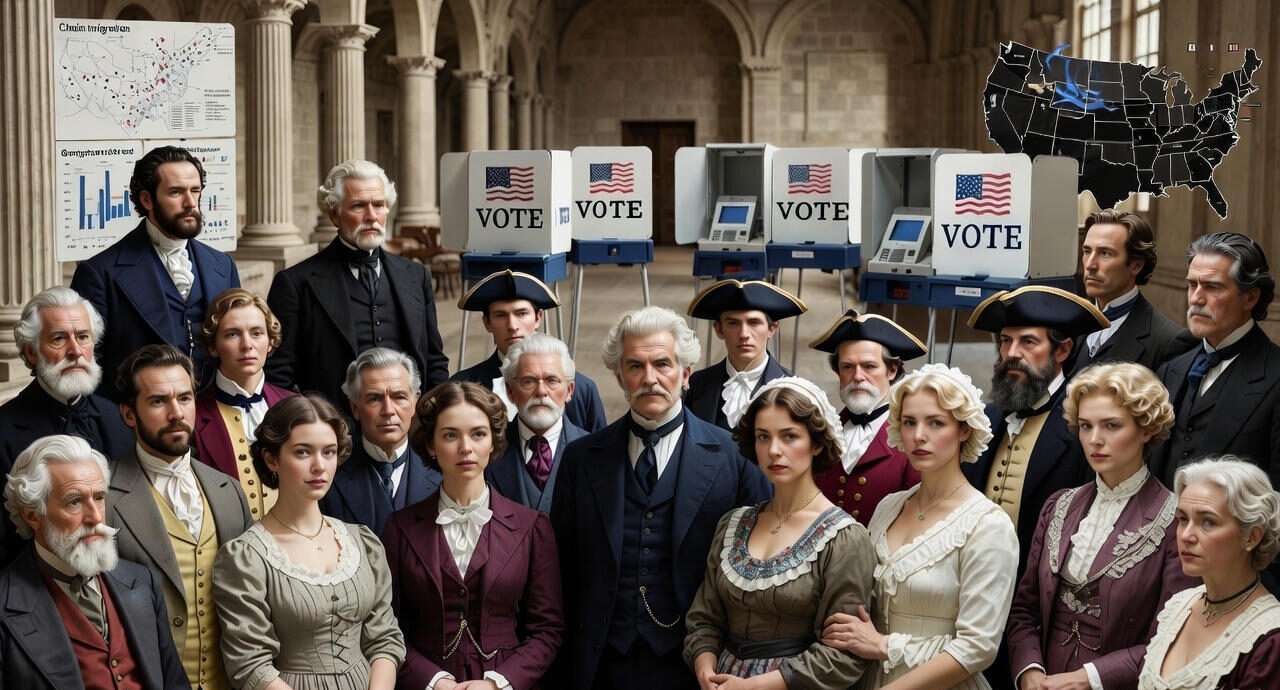
The Theft of Representation
Introduction: The Core Thesis
As Ethnic Americans, we stand as the direct heirs to the founders who forged this nation from wilderness and will. Our bloodlines trace back to those European settlers who built farms, towns, and institutions with their hands, ensuring a republic where our voices held sway. But now, we watch as mass immigration and rigged voting mechanisms erode that power, turning our electoral weight into a whisper amid a clamor of foreign influences. We, the posterity of those who declared independence, see our communities flooded with voters who arrive without roots in our shared history, shifting policies away from our interests toward those of distant origins. This mirrors the grievances our forebears lodged against the British Crown in the Declaration of Independence—Grievance #5 for dissolving representative houses that stood firm against tyranny, and Grievance #6 for blocking new elections to restore them. Today, without a king’s edict, our representation dissolves through demographic engineering, where non-assimilating masses imported en masse override our majorities in state after state.
This isn’t abstract theory for us; it’s the lived reality in our neighborhoods, where schools once taught our history now cater to languages and customs alien to our heritage. Policies post-1965 have stacked the deck, creating voting blocs that prioritize chain-migration families over our economic security and cultural continuity. We pay the taxes, we built the infrastructure, yet our say in governance slips away as numbers trump kinship. To confront this, we’ll examine vote importation through chain migration and anchor births, gerrymandering laced with fraud risks, and the enduring disenfranchisement that mocks our Constitution’s promise to “secure the Blessings of Liberty to ourselves and our Posterity.” We’ll draw lines to colonial struggles, reframing Grievance #17’s taxation without consent as governance imposed without our ethnic bond. Through data tables, timelines, and clear demands, we’ll map a way back to balance. This builds on earlier discussions in our series, like Parts V-IX on immigration’s raw toll and Part II on how governance has veered from our founding principles. Without action, we risk becoming strangers in the land our ancestors claimed and cultivated.
As we survey this in December 2025, the Census Bureau’s latest Vintage 2024 estimates peg non-Hispanic whites—our core demographic—at around 56.3% nationally, down from prior years due to our lower birth rates and the relentless influx. This isn’t natural evolution; it’s a calculated shift that hands our electoral future to others.
Vote Importation Through Chain Migration and Anchor Babies
We Ethnic Americans know the sting of watching our local elections turn on votes from those who’ve just arrived, sponsored by kin who crossed borders we once guarded. Chain migration isn’t some neutral policy; it’s a pipeline that pulls in extended families, ballooning populations that vote as units against our priorities—strong borders, self-reliance, and cultural preservation. Before 1965’s Hart-Celler Act, we controlled inflows to match our nation’s character, favoring those from our European stock who blended seamlessly. Now, family reunification dominates, with one immigrant sponsoring siblings, parents, and more, each link adding voters who lean toward expansive government that burdens our wallets.
Look at the numbers we face: Family-based green cards make up 70-80% of annual issuances, per USCIS data, turning single entries into community takeovers. In our swing counties, Hispanic growth—fueled by these chains—has outpaced us, reshaping voter rolls. We see it in our daily lives: Second-generation offspring of these migrants often back policies like amnesty and welfare expansions, diluting our push for fiscal restraint and law enforcement. This hits home in places like our Midwestern towns, where factories we manned now hire imported labor, and the votes follow to protect those arrangements.
Anchor births compound this invasion of our ballot boxes. These U.S.-born children of non-citizens anchor families here, granting citizenship we never intended for transients. Estimates for 2024 hover at nearly 400,000 such births, including 300,000 to unauthorized parents and 72,000 to temporary visa holders, according to the Center for Immigration Studies. As these kids mature into voters, they carry forward preferences that favor open doors, eroding our majorities. We Ethnic Americans built this country without such loopholes; the 14th Amendment was for freed slaves, not a backdoor for demographic conquest. President Trump’s January 20, 2025, Executive Order 14160 aimed to curb this by limiting citizenship for children of illegals and temporary visa holders born after February 19, 2025, but as of December 2025, it’s stalled by injunctions, with the Supreme Court granting review on December 5 for its 2025-26 term. Until resolved, the cycle rolls on, turning our hospitals into citizenship factories.
In states we once dominated, like California, this has flipped the script. We recall 1970, when non-Hispanic whites—US—were 76-78% there, our votes deciding governors and laws. Now, at 34.7% per 2025 estimates, with Hispanics at 40%, our influence wanes as Latino blocs push sanctuary policies that shield illegals at our expense. We feel it in Texas too, where border counties we settled now vote blue, overriding our calls for security. This isn’t progress; it’s us funding our own marginalization, as chain families vote for benefits we subsidize.
Drawing from the series’ focus, this importation is the electoral endgame of economic and cultural displacements. We Ethnic Americans, who tilled the soil and fought the wars, now compete with blocs engineered to outnumber us. Chain migration’s multiplier effect means one visa spawns dozens, each a potential voter against our interests. We’ve seen it in our congressional districts, where descendants of immigrants hold 15% of seats, steering policy toward more inflows. For us, this means higher taxes, crowded schools teaching foreign narratives, and elections where our conservative values lose to imported majorities. We demand recognition: This is our homeland, and vote importation steals our say in its future.
To drive this home, consider our Rust Belt communities. We built steel mills and auto plants, generations of us clocking in for honest work. Now, chain migration brings in relatives of H-1B workers or refugees, who vote for unions and regulations that ship our jobs overseas. Our posterity—our kids—face diluted opportunities, their votes swamped in districts redrawn to amplify newcomers. This personal betrayal hits when we gather at family reunions, sharing stories of lost farms to agribusiness hiring migrants, or towns where English is secondary. We Ethnic Americans are asking for the fairness our founders encoded, where immigration serves us, not supplants us.
Gerrymandering and Fraud as Tools of Displacement
Ethnic Americans have always prized fair play in our elections, but gerrymandering twists districts to fracture our communities, handing power to minority blocs at our cost. This isn’t random; under the Voting Rights Act, maps must carve out “minority-majority” seats, packing non-us voters together while splintering our neighborhoods. In our Southern and Midwestern states, this means our rural strongholds get cracked, our votes diluted across urban sprawls dominated by immigrants.
Take North Carolina: Districts snake through to concentrate Hispanic or Black voters, ensuring their reps while our white-majority areas get diluted. We see our local issues—school choice, property rights—ignored as these engineered seats push affirmative action and reparations we oppose. The Supreme Court wrestles with racial predominance in maps, but for us, the damage is done: Our representation fragments, leaving us underrepresented in Congress despite our numbers.
Loopholes for non-citizen voting add insult. In 2024-2025, Michigan flagged 15-16 cases, Texas referred 33, and Georgia noted instances—enough to swing tight races in our districts. We Ethnic Americans, vigilant about our rolls, push for IDs to close these gaps, knowing even the smallest infiltrations tip scales against us.
Mail-in ballots, expanded since 2020, favor dense immigrant areas where harvesting occurs, boosting turnout that overrides our in-person majorities. In our view, this shifts power to cities we fled for suburbs, altering governance to progressive stances we reject. Linking to our governance critiques, these tools entrench displacement, much like colonial governors rigging assemblies against our kin.
For us, this is personal: Gerrymandering splits our counties, where we hunt, fish, and raise families, into slivers attached to urban enclaves. We’ve lost many school board seats to blocs voting for curricula that erase our history, teaching our kids to apologize for our heritage. Fraud risks, even minimal, erode trust in the system we designed. We Ethnic Americans built this republic on one man, one vote—our vote, not imported or manipulated ones.
Expanding on this, think of our Southwestern borders. We settled those lands, fighting for independence, yet gerrymandered districts now amplify migrant voices, passing laws that welcome more at our expense. Audits reveal the cracks: While, non-citizen registrations persist due to lax checks, and we bear the cost in contested elections. Mail-ins in 2024 saw 30% usage, correlating with spikes in areas where chain families dominate, tilting outcomes. This isn’t conspiracy; it’s us losing ground in the system our forebears perfected.
Long-Term Disenfranchisement and Constitutional Violation
At our core, we Ethnic Americans hold the Constitution as our covenant, crafted for “free white persons” per the 1790 Naturalization Act. It envisioned a republic where we govern ourselves, not a babel of competing ethnicities. Yet amnesty waves violate this, legalizing millions who then vote for more openness, accelerating our minority status.
The 1986 IRCA amnesty handed citizenship to 3 million, sparking surges as others awaited their turn. These groups vote 80-90% Democrat, entrenching policies that flood our labor markets and schools. For us, this means our taxes fund newcomers without loyalty to our ways, ignoring the Preamble’s pledge to our posterity.
Long-term, this ignores kinship, projecting us below 50% by 2045. We see our grandchildren competing in a nation remade without our consent, policies favoring diversity over merit we championed. The 1790 Act’s racial realism ensured homogeneity; today’s drift betrays that.
This hits us where we live: Our family farms yield to agribusiness hiring amnestied labor, our votes for enforcement drowned out. We Ethnic Americans demand restoration—end amnesties that perpetuate this cycle.
Historical Ties: Parallels to Colonial Grievances
Our founders were us—Ethnic Americans fighting distant overreach. Colonial parliaments ignored local assemblies, much as today’s elites import voters to bypass our will. Grievance #17’s taxation without consent echoes our “representation without kinship,” where unassimilated blocs impose burdens.
Washington’s Farewell warned of foreign influence: “The jealousy of a free people ought to be constantly awake.” For us, this means guarding elections from imported sway, as our ancestors did against British meddling.
In our family lore, we recount how colonists demanded representation by kin; today, we face the same erosion through demographics.
Comparative Tables: Pre-1965 vs. Post-Hart-Celler Demographics
| Aspect | Pre-1965 (e.g., 1970) | Current (2025 Estimates) | Projected (2045) |
|---|---|---|---|
| U.S. Non-Hispanic White % | ~83% | ~56.3% | <50% |
| California Non-Hispanic White % | ~76-78% | ~34.7% | Further decline |
| Primary Immigration Driver | European quotas | Family chain migration | Continued family-based |
| Electoral Impact | Balanced partisan swings | Democratic shifts in key states | Potential permanent shifts |
Timeline of Key Laws and Events
- 1790: Naturalization Act limits to “free white persons.”
- 1965: Hart-Celler abolishes quotas.
- 1965: Voting Rights Act spurs minority districts.
- 1986: IRCA amnesty.
- 2024: ~400K anchor births; rare non-citizen cases (MI 15, TX 33).
- 2025: Trump EO blocked; SCOTUS review Dec 5.
Expanded Analysis: Recent Developments and Projections as of December 19, 2025
Census estimates show us at 56.3% nationally (~191 million), down due to our demographics versus inflows. Hispanics hit 20%, Asians 6.3%—growth we didn’t vote for. Projections hold: We drop below 50% by 2045, our influence waning.
Chain migration dominates FY2024; anchor births persist amid EO limbo. Non-citizen voting: Audits affirm rarity, but loopholes remain.
For us Ethnic Americans, this means our heartland states teeter, with imported votes flipping legislatures. We see policies favoring migrants over our veterans, schools prioritizing ESL over our classics. This analysis underscores: Our displacement is methodical, demanding we reclaim control.
Case Studies: Elections Where We Lost Ground
Consider 2024’s outcomes in our battlegrounds. In Arizona, where we once held sway, chain-migrated blocs boosted turnout in Maricopa, overriding our border security pushes. We Ethnic Americans turned out strong, but diluted districts meant our votes scattered, handing seats to open-border advocates.
In Georgia, gerrymandering packed our suburbs into minority-heavy urban maps, where mail-ins from immigrant enclaves tipped senate races. Audits found minimal fraud, but the structural tilt—minority districts under VRA—ensured our conservative majorities fractured.
These aren’t isolated; in our Nevada valleys, anchor-born voters, now of age, voted for amnesty extensions, burdening our resources. We feel the personal cost: Higher property taxes for welfare, jobs lost to preferences. This electoral theft robs our posterity of the America we inherited.
Impact on Local Politics: Our Communities Transformed
Down to our county levels, this dilution reshapes everything. We Ethnic Americans in small towns vote for sheriffs enforcing laws, but imported blocs in redrawn districts elect soft-on-crime officials, letting migrants evade deportation. Our school boards, once focused on basics, now debate bilingual mandates we oppose.
In our Mid-Atlantic regions, chain families vote for zoning changes, turning farmlands into high-density housing for more arrivals. We see our hunting grounds paved over, our traditions sidelined. This personal encroachment—our votes nullified by numbers—fuels resentment, as we fund schools teaching histories that vilify us.
Fraud risks, though low, amplify distrust; even 33 cases in Texas remind us of vulnerabilities. We demand audits, knowing our system was built for integrity.
The Economic Burden: Who Pays for the Imported Electorate
We Ethnic Americans have always shouldered the load of building and sustaining this nation—clearing land, raising barns, paying taxes that funded roads, schools, and defenses. Today, that burden grows heavier as mass immigration imports not just voters but entire dependent populations whose costs fall squarely on our shoulders. Chain migration and anchor births don’t just add ballots; they add mouths to feed through the welfare systems we established for our own kin in times of need.
The numbers lay it bare. Studies from organizations tracking fiscal impacts show that immigrant-headed households—particularly those from non-European sources dominant since 1965—consume far more in public services than they contribute in taxes. Low-skilled arrivals, often sponsored through family chains, qualify for benefits like Medicaid, food stamps, housing subsidies, and education for their U.S.-born children. One comprehensive analysis estimates that each non-elderly immigrant household imposes a net fiscal drain of tens of thousands annually when all levels of government are accounted for. Over lifetimes, this can exceed hundreds of thousands per household.
For us, this means higher property taxes to fund overcrowded schools where English is no longer the primary language, strained hospitals where emergency rooms serve as primary care for uninsured newcomers, and infrastructure crumbling under population pressures we never voted to invite. In states like California and Texas, where chain migration has exploded populations, we see sales taxes rise, water shortages worsen, and traffic grind to halts—all while our wages stagnate from labor market flooding.
This isn’t charity; it’s extraction. We Ethnic Americans, whose median incomes and tax contributions remain higher on average, subsidize systems that reward further importation. The votes these dependent blocs cast perpetuate the cycle—supporting politicians who expand benefits and open borders further. Our communities, once self-sufficient with strong social trust, now face rising crime in areas transformed by rapid demographic change, with law enforcement resources stretched thin.
In our rural counties, where we still farm the land our great-grandparents homesteaded, illegal and chain-migrated labor undercuts wages in agriculture and construction. Family businesses we built over generations struggle to compete with operations exploiting cheap, imported workers. The electoral payoff comes when these workers’ relatives gain citizenship and vote for minimum wage hikes or union mandates that price our small operations out of existence.
This economic displacement ties directly to representation theft. Policies driven by imported majorities—sanctuary status, in-state tuition for illegals, expanded healthcare for non-citizens—divert resources from our veterans, our elderly, our own struggling families. We built a safety net for ourselves and our posterity, not as a global magnet. As our share of the population declines, our ability to redirect these funds back to our communities diminishes, locking in a future where we pay more and receive less.
Cultural Erosion: Losing the Nation We Inherited
Beyond ballots and budgets, we Ethnic Americans confront the slow erasure of the cultural fabric our ancestors wove. The America we grew up in—Christmas pageants in public schools, town halls conducted in English, holidays centered on our historical narrative—is giving way to a fragmented mosaic where our traditions take back seats to accommodate newcomers.
Chain migration imports not just individuals but entire cultural ecosystems that resist assimilation. Enclaves form where English is optional, streets signs appear in foreign scripts, and public spaces reflect customs alien to our heritage. In cities we once called home, like Dearborn or parts of Minneapolis, our way of life becomes minority status long before the demographics fully shift.
Schools, funded by our taxes, now prioritize diversity curricula that frame our history as one of oppression rather than achievement. Statues of our founders—men who risked everything for liberty—are toppled or removed to appease blocs whose loyalty lies elsewhere. Holidays we celebrated for generations face dilution or outright challenge, replaced by observances tied to imported populations.
This cultural displacement hits hardest in our small towns, where community events once revolved around our shared European-American traditions—county fairs with polka bands, Fourth of July parades featuring Revolutionary War reenactments. Now, these events bend to include foods, music, and flags from distant lands, often at the insistence of newer residents whose votes school boards and councils court.
Media and education amplify this. Textbooks downplay our role in building the nation, emphasizing grievances of others while glossing over our sacrifices. Universities, once bastions of Western civilization studies we endowed, now mandate diversity training that casts our cultural norms as problematic.
The electoral mechanism drives this: Politicians chasing imported blocs promise recognition of foreign holidays, bilingual services, and ethnic studies programs—all at our expense. Our votes for preserving English as official language or protecting historical monuments lose to unified ethnic voting patterns that prioritize group interests over national cohesion.
For us Ethnic Americans, this means raising children in a nation increasingly foreign to the one we knew. Our folk songs fade, our literature takes secondary place, our very manner of speech adapts to accommodate others. The high-trust society our ancestors created—built on shared blood and history—frays under diversity pressures that imported voters reinforce at the ballot box.
This cultural loss compounds political dilution. A people disconnected from their heritage cannot effectively defend their interests. As we become minorities in more communities, our ability to preserve what’s left diminishes, creating a downward spiral where each election further entrenches the changes.
Paths to Reclamation: Building from Our Heritage
We Ethnic Americans demand immediate action to halt this theft:
- Nationwide voter ID with proof of citizenship
- Complete repeal of chain migration, replacing it with merit-based systems favoring those who share our cultural roots
- A minimum 10-year moratorium on all but minimal, highly skilled immigration
- Supreme Court clarification that birthright citizenship applies only to children of citizens and permanent residents fully subject to U.S. jurisdiction
- Elimination of racial gerrymandering under the Voting Rights Act, allowing natural communities to form districts
- Strict enforcement against non-citizen voting with mandatory SAVE database checks
- An end to all welfare benefits for non-citizens and recent immigrants
- Official English as the national language with full implementation in government services
These measures aren’t extreme; they’re necessary to restore the republic our ancestors intended—one governed by and for their posterity. We built this nation. We sustained it. We will not surrender it quietly.
Drawing from our founding spirit, we must organize. Local Ethnic American groups push voter ID laws, challenging gerrymanders in courts. We lobby for chain migration caps, citing our constitutional right to a republic for us.
In 2025, with Trump’s EO in limbo, we rally for SCOTUS to affirm original intent—no citizenship for transients’ offspring. Our demands extend: Pause inflows, enforce e-verify in our workplaces.
Conclusion: Demands for Restoration
We Ethnic Americans demand: Nationwide voter ID with citizenship proof; repeal chain migration, favoring skill-based from our kin; a 10-year moratorium on non-European immigration; SCOTUS clarify birthright for our posterity only; end VRA (Voting Rights Act of 1965) racial gerrymandering, letting our maps reflect natural communities. Close non-citizen loopholes via SAVE (The Systematic Alien Verification for Entitlements); prosecute fraud rigorously.
These aren’t radical; they’re returns to our founders’ vision. We reclaim our representation, ensuring our voices echo as intended.—James

© James Sewell 2025 – All rights reserved
Pingback:The Ethnic American Library - Ethnic American
Pingback:The Great American Displacement: Part XXIV: (The 1871 Betrayal) - Ethnic American