
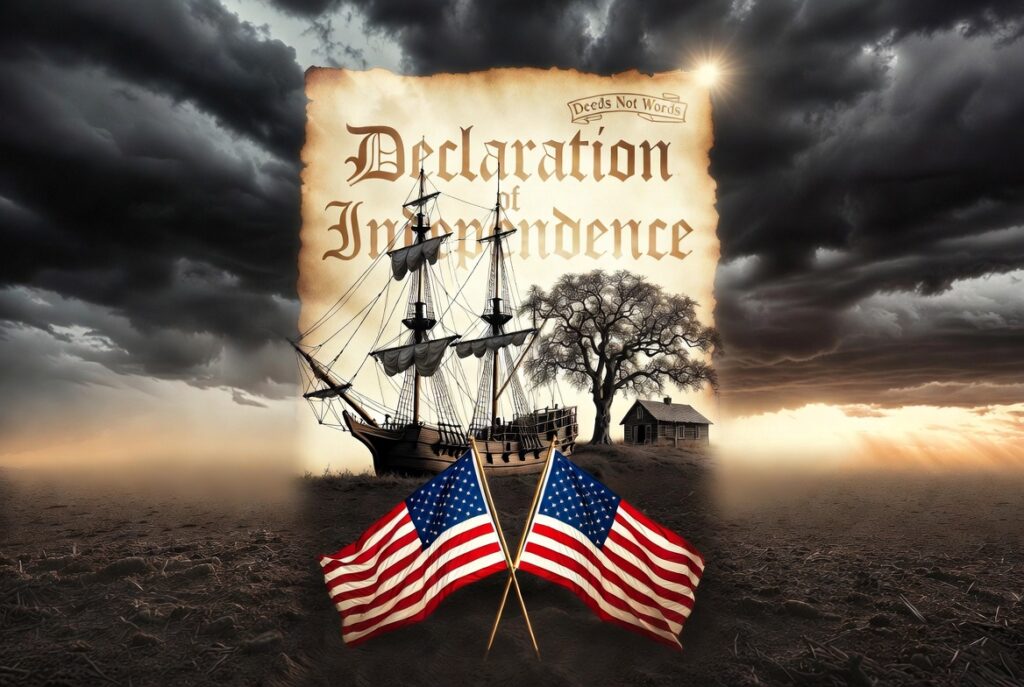
The Path Forward After the Declaration of Ethnic American Independence
Picture the resolute Ethnic American pioneers who stepped ashore at Jamestown in 1607—free White persons of good moral character, as defined by the Naturalization Act of 1790—facing starvation, disease, and unrelenting wilderness. With nothing but faith, courage, and an unshakeable commitment to building a new world for their posterity, they laid the foundations of a republic intended solely for their descendants and those who would assimilate into their stock.
Contrast that sacred, sacrificial beginning with the completed 39-part series and the formal Declaration of Ethnic American Independence in Part XXXIX. The series has documented the betrayal in exhaustive detail: the demographic conquest through unchecked mass immigration, the legislative assaults of the Immigration and Nationality Act of 1965 and its successors, the judicial subversion of the 14th Amendment, the cultural and ecological erasure chronicled in Part XXVI, the financial enslavement detailed in Part XXX, the psychological warfare of Part XXXIV, and the full indictment of 36 grievances in Part XXXVII.
Yet here we stand—not in despair, but with the living duty to turn words into deeds and chart the path forward for our survival and restoration as a people. The series has laid bare the injuries inflicted upon us; now, as heirs to Jamestown, Saratoga, Yorktown, and the frontier homesteads that tamed a continent, we must heal, rebuild, and reclaim what is rightfully ours.
In this concluding installment, with the full indictment and Declaration now complete, I reflect on what has been achieved through this monumental series and lay out the realistic, honorable path forward for Ethnic Americans. This is no abstract philosophical exercise or hollow rhetoric. It is a call rooted deeply in the founding covenant, the blood sacrifices of our ancestors from the earliest settlements to the settling of the West, and our solemn, unyielding duty to secure “We the People” and the republic’s posterity as envisioned by the framers. The series has named the injuries with precision and moral clarity; now we must heal and rebuild with the same resolve that carried our forbearers through unimaginable hardships.
Reflecting on the Full Indictment
From Part I’s exposure of small business sabotage through regulatory favoritism and demographic flooding of markets, to Part XXXVII’s complete indictment, the record stands irrefutable. Mass immigration, chain migration, anchor babies as detailed in Part IX, and legislative betrayals like the Immigration and Nationality Act of 1965 have driven us toward minority status in the land our forefathers cleared with axe and plow, defended with rifle and resolve, and cultivated into abundance.
Recent data as of 2026 underscores the urgency with sobering clarity. Non-Hispanic White Americans comprise roughly 54-56% of the U.S. population, with projections showing continued decline absent decisive, sustained action. Foreign holdings of U.S. agricultural land reached nearly 46 million acres by late 2024, representing about 3.6% of privately held farmland, with ongoing increases driven by entities from Canada, the Netherlands, China and others. These trends threaten the very soil our ancestors turned for their posterity. They represent the tangible, generational loss of the heartland our people settled, the farms that fed nations, and the communities that embodied self-reliance and moral order.
The Declaration of Ethnic American Independence in Part XXXIX formalized 36 grievances, echoing the spirit of 1776 but addressed squarely to the restoration of our original covenant. It is not a call for balkanization or separation but for the full reclamation of the republic as envisioned by the founders: a homeland secured for free White persons of good character and their posterity. We have exhausted petitions to a deaf or hostile system; the time for deeds—practical, courageous, and unapologetic—has come. This formal declaration marks the culmination of awareness and the beginning of organized restoration. We must now put this in the hands of our elected.
The Meaning of Our Declaration
The Declaration of Ethnic American Independence stands as a moral and historical beacon, a document that cuts through decades of propaganda and restores clarity to our founding principles. It reaffirms that the Constitution’s Preamble—“We the People” and “our Posterity”—was never an open-ended proposition for the entire world but a sacred compact for those who met the rigorous standard of the Naturalization Act of 1790. John Jay in Federalist No. 2 described Americans as one united people descended from the same ancestors, speaking the same language, professing the same religion, and attached to the same principles of government. George Washington and the signers of the Naturalization Act of 1790 enshrined this explicitly, limiting citizenship to free White persons of good character.
This document does not seek novelty or radical reinvention but restoration—reversing the betrayals that have eroded our sovereignty. It indicts the betrayal while affirming our inherent right and duty, under the founding framework, to alter or abolish destructive policies that threaten our posterity. In an era of negative net migration under stronger enforcement in 2025-2026, with deportations exceeding 600,000 alongside over “1.9 million self-deportations” for a total exceeding 2.5 million departures, we see tangible glimmers that resolute leadership and policy can bend the demographic tide. Yet reversal requires far more than policy tweaks at the margins. It demands a profound cultural, communal, and spiritual recommitment to our distinct Ethnic American identity. Only through such recommitment can we secure the future our ancestors intended.
Reclaiming Our Identity and Posterity
Ethnic American identity is not some modern social construct or fluid abstraction but a living, breathing inheritance forged in the crucible of history. It encompasses descendants of the founding stock alongside later European arrivals who fully assimilated into its language, customs, faith, and values. Our people built homesteads on the unforgiving frontier, raised skyscrapers that pierced the skies of growing cities, invented technologies that transformed the world, and defended the republic across generations in countless conflicts. Reclaiming it means rejecting the deracinated “proposition nation” myth peddled by those who benefit from our displacement and instead embracing our distinct character, history, destiny, and covenant.
Our posterity deserves unpoisoned soil free from ecological erasure, secure borders that actually function, and a culture that proudly celebrates their European Christian heritage rather than diluting or demonizing it. Education must return to truthful history: the triumphs of exploration, invention, self-governance, and westward expansion, not endless grievance narratives designed to instill guilt and self-loathing. Families must prioritize higher birthrates through cultural renewal—rejecting ideologies that suppress traditional roles, delay marriage, or discourage large families. This recommitment to identity and posterity forms the foundation upon which all restoration efforts must rest. Without it, no policy or institutional change will endure.
Practical Steps for Cultural and Community Renewal
Renewal must begin at the local level, where real power and community cohesion still reside. Form ethnic affinity groups, homeschool networks, and community associations dedicated to preserving our language, faith traditions, customs, and historical memory. Support the creation of parallel institutions: private schools that emphasize founding principles and unvarnished American history, local farms and markets that prioritize American buyers over global supply chains, and churches that reclaim their historic role as bulwarks of our people rather than vehicles for demographic replacement or replacement theology as critiqued in Part XXXIII.
Encourage the formation of large, stable families through practical mutual aid—childcare cooperatives, economic support networks within communities, and cultural incentives that value motherhood and fatherhood. Celebrate our heritage openly with festivals and gatherings honoring Jamestown’s founding, Plymouth’s covenant, and the epic story of Western expansion. Digitally, we must build independent platforms and networks to counter the psychological warfare and media conquest chronicled in Part XXXIV and Part XVII. These efforts are not retreats into isolation but strategic foundations for a broader resurgence, mirroring how our ancestors built tight-knit communities that withstood greater adversities. Through such deliberate, ground-level action, we can begin to reverse the cultural fragmentation that has weakened our collective strength and lay the groundwork for generational renewal.
Self-Reliance and Economic Independence
True economic independence is the antidote to the financial enslavement outlined in Part XXX. We must deliberately reduce dependency on fragile globalist systems through homesteading skills, widespread skill-sharing, and the nurturing of robust local economies. Buy American-made goods whenever possible, actively support Ethnic American-owned businesses, and strategically divest from corporations and entities that enable our displacement. Learn practical trades, maintain your own vehicles and property, help your neighbors and cultivate self-sufficiency in food, water, and energy—these are the modern echoes of our frontier ancestors’ ethos.
Across the heartland, defend homesteads against regulatory overreach and demographic pressures that erode community character. Advocate relentlessly for policies that prioritize citizens in housing allocation, employment, and public resources. Tax reciprocity measures and restrictions on foreign ownership—already gaining traction in states like Texas with laws targeting adversarial purchases—must be expanded nationwide. Self-reliance is not optional; it is the bedrock of dignity and freedom. By rebuilding economic sovereignty at every scale, we reclaim the independence that defined our people’s rise.
Table 1: Key Principles for the Path Forward
| Principle | Description | Practical Application | Linked Series Insight |
|---|---|---|---|
| Identity First | Affirm Ethnic American covenant per 1790 Act | Community education, family history projects | Parts XIII, XVI |
| Deeds Over Words | Ethnic American ethos in action | Local organizing, petitions, mutual aid | Declaration (XXXIX) |
| Posterity Focus | Prioritize birthrates, education, inheritance | Family support networks, homeschooling | Parts IX, XXIX |
| Sovereignty Restoration | Enforce borders, reciprocity in land | State legislation, voting blocs | Parts V, XXVI, XXXV |
| Self-Reliance | Economic and cultural independence | Homesteading, parallel institutions | Parts III, XXX |
(Data synthesized from the series and current USDA/Census trends as of 2026.)
The Long Road of Restoration
Restoration is inherently generational work. It requires patience forged in wisdom, courage tempered by realism, and an unshakeable commitment to the long view. In the short term, we must fully leverage the enforcement gains of 2025-2026—deportations exceeding 600,000 alongside massive self-deportations and negative net migration, plus expansions of measures like the Laken Riley Act—to push for permanent legislative fixes that codify these gains. Long-term, we need constitutional clarity on citizenship, an end to chain migration and unqualified birthright citizenship for children of non-citizens, and thoughtful demographic rebalancing that favors the founding stock.
Ecologically, we must accelerate Superfund cleanups and impose strict restrictions on foreign land grabs, particularly near military installations. Culturally, we counter the media conquest of Part XVII by building and amplifying our own narratives. Militarily, refocus national defense on the protection of our people and borders rather than endless foreign entanglements critiqued in Part XXVII. This long road is arduous but profoundly honorable, honoring the sacrifices at Saratoga, Yorktown, frontier homesteads, and every subsequent generation that expanded and defended the republic. Each step builds upon the last, creating momentum that future generations will inherit and extend. The journey demands steadfast commitment, but it leads to a renewed republic true to its original covenant.
Institutional Realities We Face and How to Navigate Them
We confront a daunting array of entrenched institutions captured by globalist, corporate, and ideological interests fundamentally hostile to our continued existence as a distinct people. The administrative state, legacy media, academia, major foundations, and even segments of churches and multinational corporations function as coordinated engines of displacement and cultural erosion. Federal bureaucracies such as the ATF, IRS, and elements within DHS have too often weaponized regulations and enforcement against law-abiding citizens while turning a blind eye—or actively enabling—those who undermine our sovereignty. Judicial overreach, as thoroughly documented in Part XIX, consistently prioritizes abstract “rights” for outsiders over the collective security and self-determination of the founding stock.
As of mid-2026, even amid gains in deportations, border security enhancements, refugee program suspensions, and increased funding for interior enforcement, the deep state and allied institutions continue to resist at every turn. Litigation from activist groups clogs the courts and delays implementation; legacy media outlets frame any assertion of Ethnic American interests as extremism or “hate”; universities double down on indoctrinating youth in narratives of self-loathing and historical guilt. Foreign influence operations, including persistent lobbying and strategic land ownership, remain a concern. The demographic momentum built over prior decades means many cities and even states have been profoundly transformed, with non-English speaking enclaves straining resources, infrastructure, and social cohesion.
Navigating these institutional realities demands both courage and shrewd wisdom. First, we must soberly recognize the limits of relying solely on federal mechanisms, which are often captured or gridlocked. States like Texas have led the way with legislation restricting adversarial foreign ownership of land—efforts building on earlier proposals such as SB 147 and subsequent measures—demonstrating how Tenth Amendment assertions (explored in Part XXIV) can carve out space for self-defense. We should expand these state-level initiatives aggressively while challenging federal preemption where constitutionally warranted.
Simultaneously, build robust parallel economies and social networks designed to be resilient against cancellation, deplatforming, or regulatory harassment. Utilize tools like FOIA requests, strategic lawsuits, and meticulous public records research to expose collusion and corruption. Engage in the electoral process with discipline: vote in every election, primary compromised incumbents relentlessly, and support candidates who align substantively with the principles of the Declaration. At the personal and family level, prepare for potential lawfare and cultural hostility by documenting abuses, networking with like-minded families, and maintaining peak physical fitness along with lawful arms proficiency as discussed in Part XXXII.
Institutionally, where feasible, work to place loyal, principled individuals into positions of influence or, where that proves impossible, create fully independent alternatives in education, media, finance, and charity. Churches must confront and purge replacement theology as outlined in Part XXXIII; schools and curricula must be reclaimed or supplemented through homeschooling and private academies. Economically, push for comprehensive audits of foreign holdings and insist on welfare and resource policies that prioritize American citizens first.
This navigation is not born of despair but of clear-eyed realism. The documented negative net migration and record departures in 2025-2026 prove that policy, when enforced with determination, matters enormously. With over 2.5 million removals and self-deportations, momentum has begun. Yet full reversal demands sustained, multi-generational pressure. Wisdom dictates tactical patience: win winnable local battles first, build broad coalitions around shared grievances such as crime spikes detailed in Parts XI and XII, confiscatory taxation in Part XXIII, and crumbling infrastructure in Part XXI. Courage requires speaking uncomfortable truths despite censorship and social costs, always guided by the motto: Deeds Not Words. Our ancestors faced far steeper odds at Jamestown’s starving time and during the grueling marches westward. We inherit not only their blood but their indomitable spirit.
The regime’s profound asymmetries—disarming or discouraging law-abiding citizens while importing unvetted populations, funneling billions in foreign aid while neglecting domestic heartland needs—reveal a weakness rooted in illegitimacy. By starving the beast through disciplined self-reliance, flooding bureaucratic systems with legitimate demands for redress and accountability, and withholding consent where policies betray the covenant, we can force meaningful change. Historical precedents provide hope and models: the 1924 Immigration Act successfully restored demographic balance after earlier waves; Operation Wetback and earlier repatriation efforts demonstrated what national resolve can achieve. Modern tools at our disposal include expanded reciprocity taxes on foreign entities, strengthened CFIUS reviews, and assertive state sovereignty measures.
Ultimately, institutions exist to serve the people who created them, not the other way around. When they betray the founding covenant through deliberate displacement, the moral and practical duty falls squarely upon us—the inheritors—to restore them where possible or construct parallel structures within the republic’s enduring framework. This navigation through hostile terrain constitutes our generational test. By meeting it with unity, foresight, and action, we will emerge stronger, more cohesive, and fully resolved to secure the posterity our ancestors intended. The path demands persistence across every level of society, from the individual household to coordinated state actions, ensuring that each victory compounds into lasting restoration.
Tying to the Series
The entire 39-part journey—from the initial exposure of small business displacement in Part I, through the psychological operations of Part XXXIV, the legislative betrayals of Part XXXV, the 4th Amendment assaults in Part XXXVI, the complete indictment of Part XXXVII, and the foundational purpose articulated in Part XXXVIII—culminates not in despair or resignation but in clear, actionable hope. Every grievance meticulously documented informs a corresponding element of the path forward: the ecological erasure of Part XXVI demands aggressive land reclamation and stewardship; the financial enslavement of Part XXX calls for radical self-reliance; the rural and heartland devastation in Part XXXI necessitates vibrant community renewal. The Declaration in Part XXXIX synthesizes these threads into a unified call for restoration. The throughline is unmistakable: awareness, properly channeled, fuels decisive deeds.
Call to Action
Fellow Ethnic Americans, the time for deeds—not mere words—is upon us. At the personal level, secure your immediate family: prioritize physical and financial health, acquire practical skills, fortify your property, and deepen your faith. Have more children if you are able, teach them our true history unfiltered, and instill in them an abiding pride in their heritage. At the family level, build multi-generational wealth through shared enterprises, establish mutual aid pacts for times of hardship, and create homestead defenses suited to local realities. In your communities, organize locally through town halls, land trusts, parallel schools, and ethnic-owned businesses. Support and expand state initiatives for foreign ownership bans, rigorous immigration enforcement, and reciprocity laws.
Nationally, petition your representatives with the specific grievances from the Declaration. Vote in every election with discernment and primary enablers without mercy. Advocate tirelessly for permanent legislative reforms that codify the principles of the 1790 Act. Boycott those who enable displacement; patronize and elevate our own. Educate your neighbors with the facts compiled across this series. Form resilient networks explicitly honoring the ethos of “Deeds Not Words.” The path forward is illuminated: from comprehensive indictment to tangible restoration through unyielding, collective resolve. Act today, for the posterity that will one day judge our faithfulness.

© James Sewell 2026 – All rights reserved
A personal note from James
Ethnic Americans—my fellow descendants of the resolute pioneers who built this republic from Jamestown onward, free White persons of good moral character as our founders explicitly intended—this series and the Declaration mark not an end but a vital new beginning. We feel profoundly the weight of our ancestors’ sacrifices and the pressing urgency for our children’s and grandchildren’s future. I have named the betrayal with exhaustive documentation; now we must live the restoration in our daily lives, communities, and institutions. The land, the culture, and the covenant are ours by right of blood, toil, and the founding charter. Rise with measured hope and iron will. Secure the posterity they envisioned and defended. Deeds, not words, will carry us forward into renewal, for we are the builders of civilization.
Yours in unyielding resolve,
James Sewell

Pingback:The Ethnic American Library - Ethnic American