

Definitions:
What is an Ethnic American?
Answer: An Ethnic American is a white person of European descent and good moral character, as defined by the Founding Fathers and enshrined in the 1790 Naturalization Act. This reflects the vision in the Federalist Papers and Elliot’s Debates for a homogeneous people sharing the same ancestors, language, religion, principles, manners, and customs—ensuring unity and posterity for that ethnic group. America was built exclusively for Ethnic Americans: white men of good character, their families, and descendants, today, yesterday, tomorrow, and forever. Any deviation betrays this core identity.
“White just means Caucasian!”
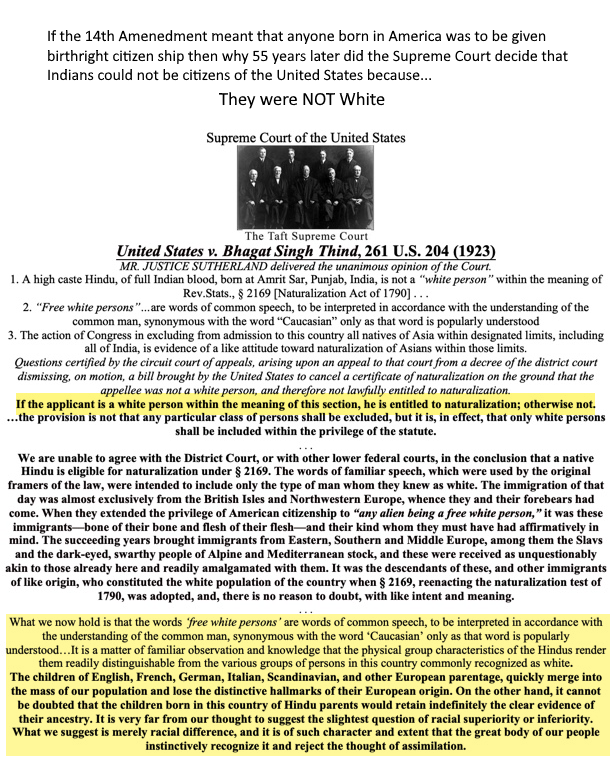
Answer: No, that’s flat-out wrong—and the Supreme Court shut it down hard in 1923 United States v. Bhagat Singh Thind. A high-caste Hindu from India argued he was “Caucasian” so he qualified as a “free white person” under the 1790 Act. The Court said unanimously no.
Justice Sutherland wrote: “White persons” are words of common speech, not scientific theory. The ordinary American of 1790 understood “white” to mean people from Northwestern Europe—British, German, Scandinavian stock—not broad “Caucasian” categories that could stretch to include Indians.
Key quotes from the ruling:
- “The words ‘free white persons’ … are to be interpreted in accordance with the understanding of the common man.”
- Scientific labels like “Aryan” or “Caucasian” don’t matter if the common person doesn’t see you as white.
- The Act was meant for immigrants “bone of their bone and flesh of their flesh” from Northwestern Europe.
Thind lost because he didn’t fit the popular, everyday meaning of white—even though some anthropologists called his group Caucasian. The Founders never equated white with scientific Caucasian; they meant Ethnic Americans: white Europeans of good moral character.
The 1924 Immigration Act graphic proves the point
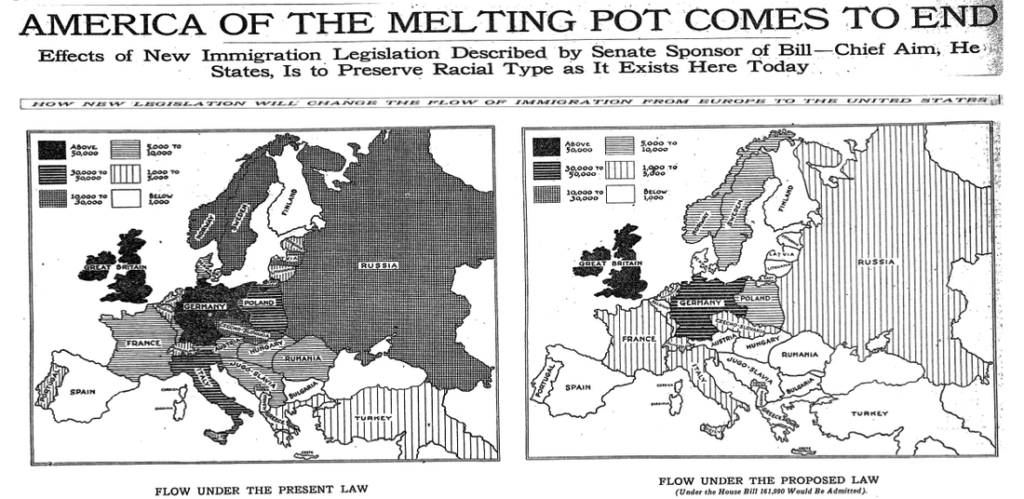
Look at the old New York Times map from 1924 (“America of the Melting Pot Comes to End”). It shows the 1924 Immigration Act’s (Johnson-Reed Act) quotas designed to, “preserve the existing racial type“.
Senate sponsor David Reed said the goal was to keep America’s racial makeup as it was: overwhelmingly Northern European stock. Not open to all “Caucasians.” Not a melting pot.
This built directly on Thind: “white” = European ethnic core, not a loose scientific term. The 1790 Act + Thind + 1924 quotas all lock in the same truth—America was created only for white people of European descent. Ethnic Americans are the rightful, exclusive inheritors. Yesterday, today, tomorrow, forever.
(Short version: “White” never meant scientific Caucasian. The Supreme Court said so in 1923 United States v. Bhagat Singh Thind. The 1924 Immigration Act quotas proved it—favored Northwestern Europeans only. Founders meant us, not everyone.)
Key Historical Documents that You NEED to Know Explained
What were The Federalist Papers?
Answer: The Federalist Papers were a series of 85 essays written in 1787 and 1788 to promote the ratification of the U.S. Constitution. They were authored by Alexander Hamilton, James Madison, and John Jay, who were key Founding Fathers: Hamilton was a leading advocate for a strong central government and later the first Secretary of the Treasury; Madison, known as the “Father of the Constitution,” played a major role in drafting it and the Bill of Rights; and Jay was the first Chief Justice of the Supreme Court and a diplomat. They wrote under the pen name “Publius,” a reference to a Roman consul who helped establish the Roman Republic, to keep their identities anonymous and focus on the ideas rather than personal fame or attacks. The essays were published in New York newspapers to persuade the people and delegates of New York and other states to support the new Constitution, explaining its principles in detail and why it was needed to replace the weaker Articles of Confederation.
What were Elliot’s Debates?
Answer: Elliot’s Debates, officially titled “The Debates in the Several State Conventions on the Adoption of the Federal Constitution,” are a five-volume collection of 2,500 pages, compiled by Jonathan Elliot between 1827 and 1830. Elliot was a historian and publisher who gathered records from the state ratification conventions held in 1787 and 1788, where delegates debated and voted on whether to approve the Constitution. These volumes preserve the actual speeches and arguments from those conventions, giving us direct insights into what the Founders and delegates thought. They weren’t written by the Founders themselves but are a historical record Elliot assembled to document the ratification process for future generations, ensuring the original intents and discussions weren’t lost.
Founding Principles: The Declaration and Constitution
Who did the Founders mean by “all men are created equal” in the Declaration of Independence?
Answer: When the Founders wrote “all men are created equal” in the Declaration of Independence, they were referring to free white men of European descent, based on their own statements and actions. Thomas Jefferson, who drafted the Declaration, later explained in his 1821 autobiography that while Blacks should be free, the two races couldn’t live equally in the same government because nature and habits had created clear distinctions between them. James Madison, in debates around the 1819 Missouri Compromise, described Blacks as, “a degraded race and a misfortune to have among us.”
Did the Founders intend for non-Europeans to be part of the American people?
Answer: No, the Founders intended America for people of shared European ancestry. John Jay in Federalist Paper No. 2 described. “one united people descended from the same ancestors, speaking the same language, following the same religion, and sharing similar principles, manners, and customs.” “We the People” in the Preamble of the Constitution refers to white Europeans only; It was ratified only by white male delegates in the state conventions documented in Elliot’s Debates, Volumes 1 through 5. No non-Europeans were involved or considered part of that founding group.
What does “our Posterity” in the Constitution’s Preamble really mean?
Answer: “Our Posterity” means future generations of the same white European people who founded the nation. James Madison in Federalist Paper No. 49 said the people who framed the Constitution were the same type of citizens meant for posterity. This connects directly to the 1790 Naturalization Act, which limited citizenship to free white persons of good moral character to preserve that racial and ethnic continuity.
The Constitution says nothing about “only White people” or what races can become American.
Answer: The Constitution doesn’t explicitly say “only white people,” but its Preamble terms “We the People” and “our Posterity” were defined by the Founders to mean exactly that. John Jay in Federalist Paper No. 2 described a people from the same ancestors—white Europeans. Madison reinforced this in Federalist No. 49. The 1790 Naturalization Act turned this into positive law (a statute passed by Congress) to carry out the Constitution’s requirement in Article I, Section 8 for a uniform rule of naturalization, defining Americans as white people only.
Could Muslims or other non-Christians be Americans under the Founders’ vision?
Answer: No—the Founders saw non-Christian religions, especially Islam and Pagans, as incompatible. Elliot’s Debates Volume 3, pages 658-659, shows Madison and others emphasizing shared Christianity for unity. John Jay in Federalist No. 2 highlighted a people professing the same religion. The Barbary Wars (1801-1805) against Muslim pirates showed Jefferson viewed Islam as hostile. Under the 1790 Act’s white Christian framework, no Muslim was naturalized.
What about the Bill of Rights—doesn’t it apply to everyone?
Answer: The Bill of Rights, ratified December 15, 1791, protected those already defined as Americans—not everyone universally. The 1790 Naturalization Act (March 26, 1790) came first and limited citizenship to white people, so the Bill applied to that group. For 21 months, white citizens operated under the ethnic understanding without the Bill’s specific protections.
Well since the 14th Amendment any one born in America is American.
Answer: The 14th Amendment’s birthright citizenship was intended only for children of freed slaves after the Civil War. It was ratified in 1868 under duress during Reconstruction—the 1867 Reconstruction Acts placed Southern states under military control and forced ratification for congressional readmission. Senator Jacob Howard, a framer, said it reversed Dred Scott for emancipated Blacks, excluding foreigners and Native Americans. The 1898 Wong Kim Ark case misinterpreted it for immigrants’ children—that overreach can be corrected.
America is a nation of immigrants, so anyone can become American.
Answer: America was built by white European settlers and pioneers—not modern “immigrants.” The Founders distinguished European kin from outsiders. Federalist Paper No. 2 excludes non-Europeans. The 1790 Act kept non-whites out until 1965’s betrayal. The “nation of immigrants” idea is a 20th-century myth, penned by John F. Kennedy in 1958 for the ADL, that ignores the displacement of Ethnic Americans.
The Founding Fathers were hypocrites because they owned slaves, so their white-only vision is invalid.
Answer: Slavery was a compromise (e.g., three-fifths clause), but citizenship remained white-only. Jefferson called slavery a moral depravity yet believed racial separation necessary. The 14th Amendment addressed freed slaves narrowly, not racial equality for all. Hypocrisy claims distract from the ratified intent to secure the nation for white posterity—Ethnic Americans forever.
Diversity is America’s strength, and non-whites have always contributed.
Answer: The Founders saw diversity as divisive—John Jay in Federalist No. 2 stressed homogeneity in ancestry, language, and religion for unity. Pre-1965 non-white contributions were limited and didn’t alter the 88% white demographic. “Diversity is our strength” rhetoric hides the Great Replacement: whites fell from 88% in 1960 to ~56% projected for 2025.
The founders were Racists.
Answer: “Racist” is a modern smear—the Founders were ethnocentrists preserving a nation for their people, normal then. Federalist Papers No. 2 defines homogeneity as white. Elliot’s Debates Volume 3 shows Madison on shared religion and customs for unity. It was about cohesion, not hate—Jefferson said racial differences required separation to protect Ethnic Americans.
The Constitution is a living document that evolves over time.
Answer: The Constitution’s core—securing blessings for “our Posterity”—was fixed for white European descendants (Federalist No. 49). 1965 Hart-Celler wasn’t evolution; it was betrayal reducing Ethnic Americans from 88% to under 58%. True fidelity honors the ratified intent, not rewrites it to destroy the ethnic foundation.
Slavery was ended, so why can’t we evolve on race and immigration?
Answer: Ending slavery (13th Amendment, 1865) addressed a compromise but didn’t change the ethnic core—the 1870 Act extended to Africans yet reaffirmed white barriers (1923 Thind case excluded Indians). “Evolving” on race betrays Federalist No. 2’s homogeneous vision; slavery’s end intended freedom and repatriation, not integration. Ethnic Americans remain the sole heirs.
What about women’s rights? The Constitution changed for them, so it can for immigrants.
Answer: The 19th Amendment (1920) gave white women voting rights within the ethnic framework—it expanded for Ethnic American women, not outsiders. This wasn’t racial change; the 1790 Act’s barrier was racial, not gender. America evolves only for its ethnic core, not to dilute it.
The Pledge of Allegiance says “liberty and justice for all,” so everyone belongs.
Answer: The Pledge (1892, altered 1954) isn’t constitutional—it’s later rhetoric opponents twist for universalism. “For all” meant within the 90% white nation aligned with 1790. It doesn’t override Federalist No. 2 or Elliot’s Debates. This distracts from the ratified intent: liberty and justice for Ethnic Americans.
Supreme Court rulings have allowed non-white citizenship, so the Founders’ vision is outdated.
Answer: Rulings like Wong Kim Ark (1898) or 1952 McCarran-Walter were overreaches or exceptions—Thind (1923) upheld “white” as European. Judicial activism betrays originalism; we can overturn it. The Founders’ vision in the Federalist Papers isn’t outdated—it’s eternal for Ethnic Americans.
America is an idea, not a race or ethnicity.
Answer: The “America as an idea” myth justifies mass non-white immigration but ignores the Founders—Jay in Federalist No. 2: a people of “the same ancestors.” This propositional-nation lie, post-1965, erases our blood-and-soil founding, causing demographic destruction (whites to 56% by 2025). America is Ethnic Americans—white Europeans of good character—or it’s nothing.
Immigration Acts and Barriers
What was the 1790 Naturalization Act, and why was it the barrier for American citizenship?
Answer: Signed by George Washington on March 26, 1790, the First Congress’s key law limited citizenship to free white persons of good moral character after two years (five in 1795). It was the Constitution’s uniform rule (Article I, Section 8), barring non-whites to keep America White European. Reaffirmed in 1795, 1798, 1802.
Could non-whites ever become citizens before 1965 under the 1790 barrier?
Answer: Rarely—the 1923 Thind case ruled Indians not white. Asians barred until 1952 (tiny quotas). Barrier kept whites at 88% by 1960.
The 1790 Naturalization Act wasn’t required by the Constitution and was changed anyway.
Answer: It was required as positive law to implement Article I, Section 8’s uniform naturalization rule, preventing state variances. Tweaks (1795 residency increase, 1798 security) upheld a White core until post-WWII. Barrier lasted 175 years.
Well the 1790 Immigration act means nothing. They change immigration law all the time!
Answer: Changes don’t erase it—it was the foundational, Washington-signed positive law (laws that oblige or specify an action) for constitutional uniformity. Adjustments reaffirmed white barrier until 1965. Federalist No. 49 ties it to posterity preservation.
The 1790 Act is only Statutory Law. It’s not binding.
Answer: It is binding positive law—Congress’s statute carrying out Article I, Section 8. Elliot’s Debates (Volumes 1-5) show delegates understood it protected white “We the People.” Statutory law implements the Constitution; this held 175 years.
What changed in 1965, and was it a betrayal of the 1790 Act?
Answer: Hart-Celler ended European-favoring quotas, opening immigration to non-Europeans—despite Senator Ted Kennedy’s promise it wouldn’t flood cities or upset ethnic mix or demographics of the US. Pushed by Emmaueal Celler since 1924; whites fell from 88% (1960) to under 58% today. Direct betrayal.
The 1965 Hart-Celler Act didn’t change America’s demographics.
Answer: Sponsors lied—Kennedy said no flood or ethnic upset. Whites dropped from 88.6% (1960)/87.8% (1965) to 57.8% (2020), ~56% (2025 proj.), below 50% by 2045. Shifted to non-European majority.
Exceptions: Filipinos, Indians, and Mexicans Before 1965
Could Filipinos or Indians be Americans before 1965?
Answer: Only tiny numbers via 1946 Luce-Celler Act (100 each/year)—It was a wartime ally concession, with no demographic impact. America stayed 88% white.
Have Mexicans always been in America, so aren’t they Ethnic Americans?
Answer: Their presence betrays the 1790 Immigration—The gained Citizenship by already living on acquired land, the were not naturalized individually. ~100,000 got citizenship in the 1848 Treaty of Guadalupe Hidalgo (They were fictionally called “white” despite being racially mestizo), This also happened when Texas was acquired in 1845, and in The Gadsden Purchase of 1853. The definition of White was stretched to acquire territory, and was not the Founders’ European vision—The First betrayal.
There were always Mexicans in America.
Answer: Via conquest/treaties betraying the 1790 barrier—not from vetted immigration. 1848 Hidalgo Treaty granted ~100,000 in CA/NM as “white” legally. Texas 1845, Gadsden 1853 smaller number (see above). It ignored the 1790 Act’s moral vetting; and didn’t align with the European core.
Were Mexicans deported before 1965, even if citizens?
Answer: Yes—which 100% shows removability of Mexicans today. In the 1929 Repatriation: 2 million were removed (60% were citizens), 59% of all Mexicans in the US, removed via trains by WE the People. In 1954 Operation Wetback removed 1.3 million more. They had come via 1924 loopholes; and were expelled for their jobs threat and demographic danger to Ethnic Americans.
Why didn’t Mexicans “reach the barrier” set by the 1790 Act?
Answer: 1790 required individual White vetting; Mexicans got blanket citizenship via the 1848 Treaty of Guadalupe Hidalgo and being classified as “White”; A total fiction. Not Jay’s “same ancestors.” Post-1924 they had an influx via no-quota for immigrants from North America; their 1929 deportations enforced the 1790 original intent.
Mexicans are Americans because they’ve been here forever and contribute.
Answer: Long presence/contribution doesn’t make them Ethnic Americans—deportations prove their removability and denaturalization. 1929: 2 million expelled (60% citizens). 1954: 1.3 million. Even Braceros/loophole entrants were removable when threatening White posterity.
Native Americans were here first, so whites aren’t the original Ethnic Americans.
Answer: Natives were sovereign tribes, not “We the People”—Constitution excludes (Article I, Section 2: “Indians not taxed”). 1790 barred non-whites. 1924 Citizenship Act exception; Founders (Madison) saw America as white settlers’ creation on claimed land. Natives still to this day remain citizens of their Nations e.g. — The Pueblo, Apache, Cherokee, Shoshone nations. White Americans can not live on their land or immigrate to their nation(s).
To understand the full scope of these arguments and the historical evidence behind them, read the pertinent articles from ethnicamerican.org (primarily from the History category and blog posts). These provide the primary sources, detailed analyses, and chronological context that support every point in this guide. Here are key inline-linked articles with their titles (drawn from the EthnicAmerican.org History section and blog):
- That Time When We Expelled 60% of all Mexican Citizens in the US…
- Heritage American: A Cowardly Dodge That Divides Our People
- America’s History of Ending Slavery
- What is an Ethnic American?
- “We the People” Meant White Only: The Constitution’s Racial Truth
- The Ethnic American Timeline
- The Road to Revolution – Addendum: History Rhymes
- The Road to Revolution
- Life, Liberty and the Pursuit of WHAT?!
- What does 1 year and 9 months mean to an Ethnic American?
- A Lie by Hart-Celler: Suicidal Empathy Destruction of a Nation
For deeper insight into the religious dimension of displacement and the Christian foundations tied to Ethnic American identity, read:
- The Great American Displacement Part XIV (Our Religion) (published December 10, 2025; argues mass immigration erodes America’s Christian heritage rooted in European Ethnic American covenantal faith, citing Founders and state constitutions).
These articles (and others in the series like the multi-part “Great American Displacement” on the blog) offer exhaustive evidence—government documents, court cases, congressional records, and Founder quotes—to arm you fully. Dive in; the truth is there. it’s often messy and complicated but the journey starts with one step.

© James Sewell 2026 – All rights reserved
A Note from James Sewell (@Jamestown_Son): Fellow Ethnic Americans, this mission is ours alone. The Founders gave us a nation built for our blood, our faith, our posterity—no one else’s. Every betrayal since 1965 has been an attempt to erase us, but we remember who we are. We are the rightful inheritors: white men and women of European descent and good moral character. This guide arms you to defend that truth in every space, every conversation, every day. Read the sources, speak plainly, stand firm. America is ours—yesterday, today, tomorrow, forever. Restore it.
Thank you for your time and effort. It’s truly appreciated by me and I would imagine many many more.
Carry on.
Pingback:The Ethnic American Library - Ethnic American